Applying Interactions
Click to focus. When focused, press m to open the options menu.
Refresh the page to restart the simulation.
Overview
The previous tutorials set the Hamiltonian . In this one, let’s place particles in an external gravitational field and add a pairwise interaction that penalizes particle overlaps:
where
- Objective: Demonstrate the use of external and pairwise potentials in MC simulations.
- File:
hoomd-rs/examples/mc-tutorial/applying-interactions.rs - Run (interactively):
cargo run --release --features "bevy" --example applying-interactions - Run (in batch mode):
cargo run --release --example applying-interactions
Bodies and Sites
The previous tutorials introduced the microstate as a collection of point bodies. That was an oversimplification. In hoomd-rs, a body is an ordered collection of sites that are defined in the local reference frame of the body. The microstate gains all of its degrees of freedom from the bodies it contains.
You get to choose the types of the body properties and the site
properties in your simulation model. At a minimum, both must have
position. The body properties (denoted as the B generic) and the
site properties (denoted by the S generic) may be the same or different.
However, the body properties type must be able to transform a site
properties from the body reference frame to the system reference frame.
All interactions on bodies are a function only of its sites and are
computed in the system reference frame. Understanding this will help as
you review the documentation for the types used later in this tutorial:
External, Linear, Boxcar, Isotropic, and PairwiseCutoff. For a
complete reference on bodies, sites, and all their related traits, read
the hoomd-microstate documentation.
In this tutorial, the bodies will still be points. Specifically, that means
each body has Point<Cartesian<2>> for its body properties type (B),
and a single site at the origin (in the body reference frame) which has
Point<Cartesian<2>> for its site properties (S) type. The constructor
Body::point() used in these tutorials is a convenient way to create point
bodies.
The next tutorial will demonstrate a case where bodies and sites have different properties and show how to create bodies with more than one site.
Use Declarations
use hoomd_geometry::shape::Rectangle;
use hoomd_interaction::{
    DeltaEnergyOne, External, MaximumInteractionRange, PairwiseCutoff,
    TotalEnergy, external::Linear, pairwise::Isotropic, univariate::Boxcar,
};
use hoomd_mc::{Sweep, Translate, Trial};
use hoomd_microstate::{
    Body, Microstate, SiteKey, boundary::Closed, property::Point,
};
use hoomd_simulation::{Simulation, macrostate::Isothermal};
use hoomd_spatial::VecCell;
use hoomd_vector::Cartesian;

// Remove the cfg_attr(...) line when using this code outside the hoomd-rs/examples directory.
#[cfg_attr(feature = "bevy", derive(Resource))]
struct Fill {
    /// Positions of all the bodies in the simulation.
    microstate: Microstate<
        Point<Cartesian<2>>,
        Point<Cartesian<2>>,
        VecCell<SiteKey, 2>,
        Closed<Rectangle>,
    >,
    /// How sites interact with other sites and fields.
    hamiltonian: Hamiltonian,
    /// Trial moves to apply.
    translate_sweep: Sweep<Translate<Cartesian<2>>>,
    /// Temperature set point.
    macrostate: Isothermal,
}

impl Fill {
    /// Construct a new fill simulation.
    fn new() -> anyhow::Result<Fill> {
        let box_length = 30.0;
        let maximum_distance = 0.15;
        let alpha = 10.0;
        let epsilon = 1000.0;
        let sigma = 1.0;
        let macrostate = Isothermal { temperature: 1.0 };

        let linear = External(Linear {
            alpha,
            plane_origin: Cartesian::default(),
            plane_normal: [0.0, 1.0].try_into()?,
        });

        let boxcar = Boxcar {
            epsilon,
            left: 0.0,
            right: sigma,
        };
        let pairwise_cutoff = PairwiseCutoff(Isotropic {
            interaction: boxcar,
            r_cut: sigma,
        });

        let hamiltonian = Hamiltonian {
            linear,
            pairwise_cutoff,
        };

        let translate =
            Translate::with_maximum_distance(maximum_distance.try_into()?);
        let translate_sweep = Sweep(translate);

        let square = Rectangle::with_equal_edges(box_length.try_into()?);
        let vec_cell = VecCell::builder()
            .nominal_search_radius(
                hamiltonian.maximum_interaction_range().try_into()?,
            )
            .build();
        let microstate = Microstate::builder()
            .spatial_data(vec_cell)
            .boundary(Closed(square))
            .try_build()?;

        Ok(Fill {
            microstate,
            hamiltonian,
            translate_sweep,
            macrostate,
        })
    }
}

#[derive(TotalEnergy, DeltaEnergyOne, MaximumInteractionRange)]
struct Hamiltonian {
    linear: External<Linear<Cartesian<2>>>,
    pairwise_cutoff: PairwiseCutoff<Isotropic<Boxcar>>,
}

impl Simulation for Fill {
    /// Advance the simulation forward one step.
    fn advance(&mut self) -> anyhow::Result<()> {
        let boundary = self.microstate.boundary();
        let y = boundary.0.edge_lengths[1].get() / 2.0 - 0.5;
        if self.microstate.step().is_multiple_of(100) {
            self.microstate.add_body(Body::point([0.0, y].into()))?;
        }

        self.translate_sweep.apply(
            &mut self.microstate,
            &self.hamiltonian,
            &self.macrostate,
        );
        self.microstate.increment_step();

        if self.hamiltonian.linear.total_energy(&self.microstate) > 20_000.0 {
            self.microstate.clear();
        }

        Ok(())
    }

    /// Get the current simulation step.
    fn step(&self) -> u64 {
        self.microstate.step()
    }
}

// Remove the cfg(not(...)) line when using this code outside the hoomd-rs/examples directory.
#[cfg(not(feature = "bevy"))]
fn main() -> anyhow::Result<()> {
    use hoomd_gsd::hoomd::HoomdGsdFile;
    use hoomd_microstate::AppendMicrostate;

    let mut simulation = Fill::new()?;
    let mut hoomd_gsd_file = HoomdGsdFile::create("applying-interactions.gsd")?;

    for _ in 0..100_000 {
        simulation.advance()?;

        if simulation.step().is_multiple_of(1_000) {
            hoomd_gsd_file
                .append_microstate(&simulation.microstate)?
                .end()?;
        }
    }

    Ok(())
}

#[cfg(feature = "bevy")]
mod applying_interactions_interactive;
#[cfg(feature = "bevy")]
use applying_interactions_interactive::main;
#[cfg(feature = "bevy")]
use bevy::prelude::Resource;
The Simulation Model
Here is the type that holds the simulation model:
use hoomd_geometry::shape::Rectangle;
use hoomd_interaction::{
    DeltaEnergyOne, External, MaximumInteractionRange, PairwiseCutoff,
    TotalEnergy, external::Linear, pairwise::Isotropic, univariate::Boxcar,
};
use hoomd_mc::{Sweep, Translate, Trial};
use hoomd_microstate::{
    Body, Microstate, SiteKey, boundary::Closed, property::Point,
};
use hoomd_simulation::{Simulation, macrostate::Isothermal};
use hoomd_spatial::VecCell;
use hoomd_vector::Cartesian;

// Remove the cfg_attr(...) line when using this code outside the hoomd-rs/examples directory.
#[cfg_attr(feature = "bevy", derive(Resource))]
struct Fill {
    /// Positions of all the bodies in the simulation.
    microstate: Microstate<
        Point<Cartesian<2>>,
        Point<Cartesian<2>>,
        VecCell<SiteKey, 2>,
        Closed<Rectangle>,
    >,
    /// How sites interact with other sites and fields.
    hamiltonian: Hamiltonian,
    /// Trial moves to apply.
    translate_sweep: Sweep<Translate<Cartesian<2>>>,
    /// Temperature set point.
    macrostate: Isothermal,
}

impl Fill {
    /// Construct a new fill simulation.
    fn new() -> anyhow::Result<Fill> {
        let box_length = 30.0;
        let maximum_distance = 0.15;
        let alpha = 10.0;
        let epsilon = 1000.0;
        let sigma = 1.0;
        let macrostate = Isothermal { temperature: 1.0 };

        let linear = External(Linear {
            alpha,
            plane_origin: Cartesian::default(),
            plane_normal: [0.0, 1.0].try_into()?,
        });

        let boxcar = Boxcar {
            epsilon,
            left: 0.0,
            right: sigma,
        };
        let pairwise_cutoff = PairwiseCutoff(Isotropic {
            interaction: boxcar,
            r_cut: sigma,
        });

        let hamiltonian = Hamiltonian {
            linear,
            pairwise_cutoff,
        };

        let translate =
            Translate::with_maximum_distance(maximum_distance.try_into()?);
        let translate_sweep = Sweep(translate);

        let square = Rectangle::with_equal_edges(box_length.try_into()?);
        let vec_cell = VecCell::builder()
            .nominal_search_radius(
                hamiltonian.maximum_interaction_range().try_into()?,
            )
            .build();
        let microstate = Microstate::builder()
            .spatial_data(vec_cell)
            .boundary(Closed(square))
            .try_build()?;

        Ok(Fill {
            microstate,
            hamiltonian,
            translate_sweep,
            macrostate,
        })
    }
}

#[derive(TotalEnergy, DeltaEnergyOne, MaximumInteractionRange)]
struct Hamiltonian {
    linear: External<Linear<Cartesian<2>>>,
    pairwise_cutoff: PairwiseCutoff<Isotropic<Boxcar>>,
}

impl Simulation for Fill {
    /// Advance the simulation forward one step.
    fn advance(&mut self) -> anyhow::Result<()> {
        let boundary = self.microstate.boundary();
        let y = boundary.0.edge_lengths[1].get() / 2.0 - 0.5;
        if self.microstate.step().is_multiple_of(100) {
            self.microstate.add_body(Body::point([0.0, y].into()))?;
        }

        self.translate_sweep.apply(
            &mut self.microstate,
            &self.hamiltonian,
            &self.macrostate,
        );
        self.microstate.increment_step();

        if self.hamiltonian.linear.total_energy(&self.microstate) > 20_000.0 {
            self.microstate.clear();
        }

        Ok(())
    }

    /// Get the current simulation step.
    fn step(&self) -> u64 {
        self.microstate.step()
    }
}

// Remove the cfg(not(...)) line when using this code outside the hoomd-rs/examples directory.
#[cfg(not(feature = "bevy"))]
fn main() -> anyhow::Result<()> {
    use hoomd_gsd::hoomd::HoomdGsdFile;
    use hoomd_microstate::AppendMicrostate;

    let mut simulation = Fill::new()?;
    let mut hoomd_gsd_file = HoomdGsdFile::create("applying-interactions.gsd")?;

    for _ in 0..100_000 {
        simulation.advance()?;

        if simulation.step().is_multiple_of(1_000) {
            hoomd_gsd_file
                .append_microstate(&simulation.microstate)?
                .end()?;
        }
    }

    Ok(())
}

#[cfg(feature = "bevy")]
mod applying_interactions_interactive;
#[cfg(feature = "bevy")]
use applying_interactions_interactive::main;
#[cfg(feature = "bevy")]
use bevy::prelude::Resource;
In order, Microstate’s generic types are the body properties, the
site properties, and the boundary condition.
Construct the Simulation Model
The new() method constructs a new simulation model:
use hoomd_geometry::shape::Rectangle;
use hoomd_interaction::{
    DeltaEnergyOne, External, MaximumInteractionRange, PairwiseCutoff,
    TotalEnergy, external::Linear, pairwise::Isotropic, univariate::Boxcar,
};
use hoomd_mc::{Sweep, Translate, Trial};
use hoomd_microstate::{
    Body, Microstate, SiteKey, boundary::Closed, property::Point,
};
use hoomd_simulation::{Simulation, macrostate::Isothermal};
use hoomd_spatial::VecCell;
use hoomd_vector::Cartesian;

// Remove the cfg_attr(...) line when using this code outside the hoomd-rs/examples directory.
#[cfg_attr(feature = "bevy", derive(Resource))]
struct Fill {
    /// Positions of all the bodies in the simulation.
    microstate: Microstate<
        Point<Cartesian<2>>,
        Point<Cartesian<2>>,
        VecCell<SiteKey, 2>,
        Closed<Rectangle>,
    >,
    /// How sites interact with other sites and fields.
    hamiltonian: Hamiltonian,
    /// Trial moves to apply.
    translate_sweep: Sweep<Translate<Cartesian<2>>>,
    /// Temperature set point.
    macrostate: Isothermal,
}

impl Fill {
    /// Construct a new fill simulation.
    fn new() -> anyhow::Result<Fill> {
        let box_length = 30.0;
        let maximum_distance = 0.15;
        let alpha = 10.0;
        let epsilon = 1000.0;
        let sigma = 1.0;
        let macrostate = Isothermal { temperature: 1.0 };

        let linear = External(Linear {
            alpha,
            plane_origin: Cartesian::default(),
            plane_normal: [0.0, 1.0].try_into()?,
        });

        let boxcar = Boxcar {
            epsilon,
            left: 0.0,
            right: sigma,
        };
        let pairwise_cutoff = PairwiseCutoff(Isotropic {
            interaction: boxcar,
            r_cut: sigma,
        });

        let hamiltonian = Hamiltonian {
            linear,
            pairwise_cutoff,
        };

        let translate =
            Translate::with_maximum_distance(maximum_distance.try_into()?);
        let translate_sweep = Sweep(translate);

        let square = Rectangle::with_equal_edges(box_length.try_into()?);
        let vec_cell = VecCell::builder()
            .nominal_search_radius(
                hamiltonian.maximum_interaction_range().try_into()?,
            )
            .build();
        let microstate = Microstate::builder()
            .spatial_data(vec_cell)
            .boundary(Closed(square))
            .try_build()?;

        Ok(Fill {
            microstate,
            hamiltonian,
            translate_sweep,
            macrostate,
        })
    }
}

#[derive(TotalEnergy, DeltaEnergyOne, MaximumInteractionRange)]
struct Hamiltonian {
    linear: External<Linear<Cartesian<2>>>,
    pairwise_cutoff: PairwiseCutoff<Isotropic<Boxcar>>,
}

impl Simulation for Fill {
    /// Advance the simulation forward one step.
    fn advance(&mut self) -> anyhow::Result<()> {
        let boundary = self.microstate.boundary();
        let y = boundary.0.edge_lengths[1].get() / 2.0 - 0.5;
        if self.microstate.step().is_multiple_of(100) {
            self.microstate.add_body(Body::point([0.0, y].into()))?;
        }

        self.translate_sweep.apply(
            &mut self.microstate,
            &self.hamiltonian,
            &self.macrostate,
        );
        self.microstate.increment_step();

        if self.hamiltonian.linear.total_energy(&self.microstate) > 20_000.0 {
            self.microstate.clear();
        }

        Ok(())
    }

    /// Get the current simulation step.
    fn step(&self) -> u64 {
        self.microstate.step()
    }
}

// Remove the cfg(not(...)) line when using this code outside the hoomd-rs/examples directory.
#[cfg(not(feature = "bevy"))]
fn main() -> anyhow::Result<()> {
    use hoomd_gsd::hoomd::HoomdGsdFile;
    use hoomd_microstate::AppendMicrostate;

    let mut simulation = Fill::new()?;
    let mut hoomd_gsd_file = HoomdGsdFile::create("applying-interactions.gsd")?;

    for _ in 0..100_000 {
        simulation.advance()?;

        if simulation.step().is_multiple_of(1_000) {
            hoomd_gsd_file
                .append_microstate(&simulation.microstate)?
                .end()?;
        }
    }

    Ok(())
}

#[cfg(feature = "bevy")]
mod applying_interactions_interactive;
#[cfg(feature = "bevy")]
use applying_interactions_interactive::main;
#[cfg(feature = "bevy")]
use bevy::prelude::Resource;
Parameters
Assign all the model parameters in one code block:
use hoomd_geometry::shape::Rectangle;
use hoomd_interaction::{
    DeltaEnergyOne, External, MaximumInteractionRange, PairwiseCutoff,
    TotalEnergy, external::Linear, pairwise::Isotropic, univariate::Boxcar,
};
use hoomd_mc::{Sweep, Translate, Trial};
use hoomd_microstate::{
    Body, Microstate, SiteKey, boundary::Closed, property::Point,
};
use hoomd_simulation::{Simulation, macrostate::Isothermal};
use hoomd_spatial::VecCell;
use hoomd_vector::Cartesian;

// Remove the cfg_attr(...) line when using this code outside the hoomd-rs/examples directory.
#[cfg_attr(feature = "bevy", derive(Resource))]
struct Fill {
    /// Positions of all the bodies in the simulation.
    microstate: Microstate<
        Point<Cartesian<2>>,
        Point<Cartesian<2>>,
        VecCell<SiteKey, 2>,
        Closed<Rectangle>,
    >,
    /// How sites interact with other sites and fields.
    hamiltonian: Hamiltonian,
    /// Trial moves to apply.
    translate_sweep: Sweep<Translate<Cartesian<2>>>,
    /// Temperature set point.
    macrostate: Isothermal,
}

impl Fill {
    /// Construct a new fill simulation.
    fn new() -> anyhow::Result<Fill> {
        let box_length = 30.0;
        let maximum_distance = 0.15;
        let alpha = 10.0;
        let epsilon = 1000.0;
        let sigma = 1.0;
        let macrostate = Isothermal { temperature: 1.0 };

        let linear = External(Linear {
            alpha,
            plane_origin: Cartesian::default(),
            plane_normal: [0.0, 1.0].try_into()?,
        });

        let boxcar = Boxcar {
            epsilon,
            left: 0.0,
            right: sigma,
        };
        let pairwise_cutoff = PairwiseCutoff(Isotropic {
            interaction: boxcar,
            r_cut: sigma,
        });

        let hamiltonian = Hamiltonian {
            linear,
            pairwise_cutoff,
        };

        let translate =
            Translate::with_maximum_distance(maximum_distance.try_into()?);
        let translate_sweep = Sweep(translate);

        let square = Rectangle::with_equal_edges(box_length.try_into()?);
        let vec_cell = VecCell::builder()
            .nominal_search_radius(
                hamiltonian.maximum_interaction_range().try_into()?,
            )
            .build();
        let microstate = Microstate::builder()
            .spatial_data(vec_cell)
            .boundary(Closed(square))
            .try_build()?;

        Ok(Fill {
            microstate,
            hamiltonian,
            translate_sweep,
            macrostate,
        })
    }
}

#[derive(TotalEnergy, DeltaEnergyOne, MaximumInteractionRange)]
struct Hamiltonian {
    linear: External<Linear<Cartesian<2>>>,
    pairwise_cutoff: PairwiseCutoff<Isotropic<Boxcar>>,
}

impl Simulation for Fill {
    /// Advance the simulation forward one step.
    fn advance(&mut self) -> anyhow::Result<()> {
        let boundary = self.microstate.boundary();
        let y = boundary.0.edge_lengths[1].get() / 2.0 - 0.5;
        if self.microstate.step().is_multiple_of(100) {
            self.microstate.add_body(Body::point([0.0, y].into()))?;
        }

        self.translate_sweep.apply(
            &mut self.microstate,
            &self.hamiltonian,
            &self.macrostate,
        );
        self.microstate.increment_step();

        if self.hamiltonian.linear.total_energy(&self.microstate) > 20_000.0 {
            self.microstate.clear();
        }

        Ok(())
    }

    /// Get the current simulation step.
    fn step(&self) -> u64 {
        self.microstate.step()
    }
}

// Remove the cfg(not(...)) line when using this code outside the hoomd-rs/examples directory.
#[cfg(not(feature = "bevy"))]
fn main() -> anyhow::Result<()> {
    use hoomd_gsd::hoomd::HoomdGsdFile;
    use hoomd_microstate::AppendMicrostate;

    let mut simulation = Fill::new()?;
    let mut hoomd_gsd_file = HoomdGsdFile::create("applying-interactions.gsd")?;

    for _ in 0..100_000 {
        simulation.advance()?;

        if simulation.step().is_multiple_of(1_000) {
            hoomd_gsd_file
                .append_microstate(&simulation.microstate)?
                .end()?;
        }
    }

    Ok(())
}

#[cfg(feature = "bevy")]
mod applying_interactions_interactive;
#[cfg(feature = "bevy")]
use applying_interactions_interactive::main;
#[cfg(feature = "bevy")]
use bevy::prelude::Resource;
box_length is the side length of the square simulation box, maximum_distance is
the largest distance a translation trial move can take, alpha is the strength of the
gravitational potential, epsilon is the strength of the pairwise potential, sigma
is the range of the pairwise potential, and macrostate holds the temperature set point
(in units of energy).
External Potential
This code implements the external potential term in the Hamiltonian:
use hoomd_geometry::shape::Rectangle;
use hoomd_interaction::{
    DeltaEnergyOne, External, MaximumInteractionRange, PairwiseCutoff,
    TotalEnergy, external::Linear, pairwise::Isotropic, univariate::Boxcar,
};
use hoomd_mc::{Sweep, Translate, Trial};
use hoomd_microstate::{
    Body, Microstate, SiteKey, boundary::Closed, property::Point,
};
use hoomd_simulation::{Simulation, macrostate::Isothermal};
use hoomd_spatial::VecCell;
use hoomd_vector::Cartesian;

// Remove the cfg_attr(...) line when using this code outside the hoomd-rs/examples directory.
#[cfg_attr(feature = "bevy", derive(Resource))]
struct Fill {
    /// Positions of all the bodies in the simulation.
    microstate: Microstate<
        Point<Cartesian<2>>,
        Point<Cartesian<2>>,
        VecCell<SiteKey, 2>,
        Closed<Rectangle>,
    >,
    /// How sites interact with other sites and fields.
    hamiltonian: Hamiltonian,
    /// Trial moves to apply.
    translate_sweep: Sweep<Translate<Cartesian<2>>>,
    /// Temperature set point.
    macrostate: Isothermal,
}

impl Fill {
    /// Construct a new fill simulation.
    fn new() -> anyhow::Result<Fill> {
        let box_length = 30.0;
        let maximum_distance = 0.15;
        let alpha = 10.0;
        let epsilon = 1000.0;
        let sigma = 1.0;
        let macrostate = Isothermal { temperature: 1.0 };

        let linear = External(Linear {
            alpha,
            plane_origin: Cartesian::default(),
            plane_normal: [0.0, 1.0].try_into()?,
        });

        let boxcar = Boxcar {
            epsilon,
            left: 0.0,
            right: sigma,
        };
        let pairwise_cutoff = PairwiseCutoff(Isotropic {
            interaction: boxcar,
            r_cut: sigma,
        });

        let hamiltonian = Hamiltonian {
            linear,
            pairwise_cutoff,
        };

        let translate =
            Translate::with_maximum_distance(maximum_distance.try_into()?);
        let translate_sweep = Sweep(translate);

        let square = Rectangle::with_equal_edges(box_length.try_into()?);
        let vec_cell = VecCell::builder()
            .nominal_search_radius(
                hamiltonian.maximum_interaction_range().try_into()?,
            )
            .build();
        let microstate = Microstate::builder()
            .spatial_data(vec_cell)
            .boundary(Closed(square))
            .try_build()?;

        Ok(Fill {
            microstate,
            hamiltonian,
            translate_sweep,
            macrostate,
        })
    }
}

#[derive(TotalEnergy, DeltaEnergyOne, MaximumInteractionRange)]
struct Hamiltonian {
    linear: External<Linear<Cartesian<2>>>,
    pairwise_cutoff: PairwiseCutoff<Isotropic<Boxcar>>,
}

impl Simulation for Fill {
    /// Advance the simulation forward one step.
    fn advance(&mut self) -> anyhow::Result<()> {
        let boundary = self.microstate.boundary();
        let y = boundary.0.edge_lengths[1].get() / 2.0 - 0.5;
        if self.microstate.step().is_multiple_of(100) {
            self.microstate.add_body(Body::point([0.0, y].into()))?;
        }

        self.translate_sweep.apply(
            &mut self.microstate,
            &self.hamiltonian,
            &self.macrostate,
        );
        self.microstate.increment_step();

        if self.hamiltonian.linear.total_energy(&self.microstate) > 20_000.0 {
            self.microstate.clear();
        }

        Ok(())
    }

    /// Get the current simulation step.
    fn step(&self) -> u64 {
        self.microstate.step()
    }
}

// Remove the cfg(not(...)) line when using this code outside the hoomd-rs/examples directory.
#[cfg(not(feature = "bevy"))]
fn main() -> anyhow::Result<()> {
    use hoomd_gsd::hoomd::HoomdGsdFile;
    use hoomd_microstate::AppendMicrostate;

    let mut simulation = Fill::new()?;
    let mut hoomd_gsd_file = HoomdGsdFile::create("applying-interactions.gsd")?;

    for _ in 0..100_000 {
        simulation.advance()?;

        if simulation.step().is_multiple_of(1_000) {
            hoomd_gsd_file
                .append_microstate(&simulation.microstate)?
                .end()?;
        }
    }

    Ok(())
}

#[cfg(feature = "bevy")]
mod applying_interactions_interactive;
#[cfg(feature = "bevy")]
use applying_interactions_interactive::main;
#[cfg(feature = "bevy")]
use bevy::prelude::Resource;
Linear computes in its energy() method.
Linear also implements the SiteEnergy trait whose method site_energy takes
a single site properties argument: . Building on that, External
wraps any type that implements SiteEnergy and sums over the energy contributed
by each site in the microstate: . External implements the
DeltaEnergyOne trait which Sweep will use to evaluate the change in energy
of a trial that moves one body.
Pairwise Potential
This code implements the pairwise potential term in the Hamiltonian:
use hoomd_geometry::shape::Rectangle;
use hoomd_interaction::{
    DeltaEnergyOne, External, MaximumInteractionRange, PairwiseCutoff,
    TotalEnergy, external::Linear, pairwise::Isotropic, univariate::Boxcar,
};
use hoomd_mc::{Sweep, Translate, Trial};
use hoomd_microstate::{
    Body, Microstate, SiteKey, boundary::Closed, property::Point,
};
use hoomd_simulation::{Simulation, macrostate::Isothermal};
use hoomd_spatial::VecCell;
use hoomd_vector::Cartesian;

// Remove the cfg_attr(...) line when using this code outside the hoomd-rs/examples directory.
#[cfg_attr(feature = "bevy", derive(Resource))]
struct Fill {
    /// Positions of all the bodies in the simulation.
    microstate: Microstate<
        Point<Cartesian<2>>,
        Point<Cartesian<2>>,
        VecCell<SiteKey, 2>,
        Closed<Rectangle>,
    >,
    /// How sites interact with other sites and fields.
    hamiltonian: Hamiltonian,
    /// Trial moves to apply.
    translate_sweep: Sweep<Translate<Cartesian<2>>>,
    /// Temperature set point.
    macrostate: Isothermal,
}

impl Fill {
    /// Construct a new fill simulation.
    fn new() -> anyhow::Result<Fill> {
        let box_length = 30.0;
        let maximum_distance = 0.15;
        let alpha = 10.0;
        let epsilon = 1000.0;
        let sigma = 1.0;
        let macrostate = Isothermal { temperature: 1.0 };

        let linear = External(Linear {
            alpha,
            plane_origin: Cartesian::default(),
            plane_normal: [0.0, 1.0].try_into()?,
        });

        let boxcar = Boxcar {
            epsilon,
            left: 0.0,
            right: sigma,
        };
        let pairwise_cutoff = PairwiseCutoff(Isotropic {
            interaction: boxcar,
            r_cut: sigma,
        });

        let hamiltonian = Hamiltonian {
            linear,
            pairwise_cutoff,
        };

        let translate =
            Translate::with_maximum_distance(maximum_distance.try_into()?);
        let translate_sweep = Sweep(translate);

        let square = Rectangle::with_equal_edges(box_length.try_into()?);
        let vec_cell = VecCell::builder()
            .nominal_search_radius(
                hamiltonian.maximum_interaction_range().try_into()?,
            )
            .build();
        let microstate = Microstate::builder()
            .spatial_data(vec_cell)
            .boundary(Closed(square))
            .try_build()?;

        Ok(Fill {
            microstate,
            hamiltonian,
            translate_sweep,
            macrostate,
        })
    }
}

#[derive(TotalEnergy, DeltaEnergyOne, MaximumInteractionRange)]
struct Hamiltonian {
    linear: External<Linear<Cartesian<2>>>,
    pairwise_cutoff: PairwiseCutoff<Isotropic<Boxcar>>,
}

impl Simulation for Fill {
    /// Advance the simulation forward one step.
    fn advance(&mut self) -> anyhow::Result<()> {
        let boundary = self.microstate.boundary();
        let y = boundary.0.edge_lengths[1].get() / 2.0 - 0.5;
        if self.microstate.step().is_multiple_of(100) {
            self.microstate.add_body(Body::point([0.0, y].into()))?;
        }

        self.translate_sweep.apply(
            &mut self.microstate,
            &self.hamiltonian,
            &self.macrostate,
        );
        self.microstate.increment_step();

        if self.hamiltonian.linear.total_energy(&self.microstate) > 20_000.0 {
            self.microstate.clear();
        }

        Ok(())
    }

    /// Get the current simulation step.
    fn step(&self) -> u64 {
        self.microstate.step()
    }
}

// Remove the cfg(not(...)) line when using this code outside the hoomd-rs/examples directory.
#[cfg(not(feature = "bevy"))]
fn main() -> anyhow::Result<()> {
    use hoomd_gsd::hoomd::HoomdGsdFile;
    use hoomd_microstate::AppendMicrostate;

    let mut simulation = Fill::new()?;
    let mut hoomd_gsd_file = HoomdGsdFile::create("applying-interactions.gsd")?;

    for _ in 0..100_000 {
        simulation.advance()?;

        if simulation.step().is_multiple_of(1_000) {
            hoomd_gsd_file
                .append_microstate(&simulation.microstate)?
                .end()?;
        }
    }

    Ok(())
}

#[cfg(feature = "bevy")]
mod applying_interactions_interactive;
#[cfg(feature = "bevy")]
use applying_interactions_interactive::main;
#[cfg(feature = "bevy")]
use bevy::prelude::Resource;
The Boxcar function implements via the
UnivariateEnergy trait.
Isotropic is a wrapper that computes
in its implementation of SitePairEnergy. The
site_pair_energy() method is a more general form that depends on the
full set of properties of the two interacting sites: . The
PairwiseCutoff type sums over all pairs of sites that are within a
distance of and do not belong to the same body:
Finally, PairwiseCutoff implements the DeltaEnergyOne trait which Sweep
will use to evaluate the change in energy of a trial move.
Important
In hoomd-rs, it is YOUR responsibility to determine the appropriate maximum for your choice of
SitePairEnergy. You might be used to other simulation codes, HOOMD-blue for example, that automatically determine this maximum for you based on the parameters of the inner types. That is not possible in hoomd-rs as yoursite_pair_energycould be any arbitrary code.
The Hamiltonian
To sum the external and pair energies, place them in a struct:
use hoomd_geometry::shape::Rectangle;
use hoomd_interaction::{
    DeltaEnergyOne, External, MaximumInteractionRange, PairwiseCutoff,
    TotalEnergy, external::Linear, pairwise::Isotropic, univariate::Boxcar,
};
use hoomd_mc::{Sweep, Translate, Trial};
use hoomd_microstate::{
    Body, Microstate, SiteKey, boundary::Closed, property::Point,
};
use hoomd_simulation::{Simulation, macrostate::Isothermal};
use hoomd_spatial::VecCell;
use hoomd_vector::Cartesian;

// Remove the cfg_attr(...) line when using this code outside the hoomd-rs/examples directory.
#[cfg_attr(feature = "bevy", derive(Resource))]
struct Fill {
    /// Positions of all the bodies in the simulation.
    microstate: Microstate<
        Point<Cartesian<2>>,
        Point<Cartesian<2>>,
        VecCell<SiteKey, 2>,
        Closed<Rectangle>,
    >,
    /// How sites interact with other sites and fields.
    hamiltonian: Hamiltonian,
    /// Trial moves to apply.
    translate_sweep: Sweep<Translate<Cartesian<2>>>,
    /// Temperature set point.
    macrostate: Isothermal,
}

impl Fill {
    /// Construct a new fill simulation.
    fn new() -> anyhow::Result<Fill> {
        let box_length = 30.0;
        let maximum_distance = 0.15;
        let alpha = 10.0;
        let epsilon = 1000.0;
        let sigma = 1.0;
        let macrostate = Isothermal { temperature: 1.0 };

        let linear = External(Linear {
            alpha,
            plane_origin: Cartesian::default(),
            plane_normal: [0.0, 1.0].try_into()?,
        });

        let boxcar = Boxcar {
            epsilon,
            left: 0.0,
            right: sigma,
        };
        let pairwise_cutoff = PairwiseCutoff(Isotropic {
            interaction: boxcar,
            r_cut: sigma,
        });

        let hamiltonian = Hamiltonian {
            linear,
            pairwise_cutoff,
        };

        let translate =
            Translate::with_maximum_distance(maximum_distance.try_into()?);
        let translate_sweep = Sweep(translate);

        let square = Rectangle::with_equal_edges(box_length.try_into()?);
        let vec_cell = VecCell::builder()
            .nominal_search_radius(
                hamiltonian.maximum_interaction_range().try_into()?,
            )
            .build();
        let microstate = Microstate::builder()
            .spatial_data(vec_cell)
            .boundary(Closed(square))
            .try_build()?;

        Ok(Fill {
            microstate,
            hamiltonian,
            translate_sweep,
            macrostate,
        })
    }
}

#[derive(TotalEnergy, DeltaEnergyOne, MaximumInteractionRange)]
struct Hamiltonian {
    linear: External<Linear<Cartesian<2>>>,
    pairwise_cutoff: PairwiseCutoff<Isotropic<Boxcar>>,
}

impl Simulation for Fill {
    /// Advance the simulation forward one step.
    fn advance(&mut self) -> anyhow::Result<()> {
        let boundary = self.microstate.boundary();
        let y = boundary.0.edge_lengths[1].get() / 2.0 - 0.5;
        if self.microstate.step().is_multiple_of(100) {
            self.microstate.add_body(Body::point([0.0, y].into()))?;
        }

        self.translate_sweep.apply(
            &mut self.microstate,
            &self.hamiltonian,
            &self.macrostate,
        );
        self.microstate.increment_step();

        if self.hamiltonian.linear.total_energy(&self.microstate) > 20_000.0 {
            self.microstate.clear();
        }

        Ok(())
    }

    /// Get the current simulation step.
    fn step(&self) -> u64 {
        self.microstate.step()
    }
}

// Remove the cfg(not(...)) line when using this code outside the hoomd-rs/examples directory.
#[cfg(not(feature = "bevy"))]
fn main() -> anyhow::Result<()> {
    use hoomd_gsd::hoomd::HoomdGsdFile;
    use hoomd_microstate::AppendMicrostate;

    let mut simulation = Fill::new()?;
    let mut hoomd_gsd_file = HoomdGsdFile::create("applying-interactions.gsd")?;

    for _ in 0..100_000 {
        simulation.advance()?;

        if simulation.step().is_multiple_of(1_000) {
            hoomd_gsd_file
                .append_microstate(&simulation.microstate)?
                .end()?;
        }
    }

    Ok(())
}

#[cfg(feature = "bevy")]
mod applying_interactions_interactive;
#[cfg(feature = "bevy")]
use applying_interactions_interactive::main;
#[cfg(feature = "bevy")]
use bevy::prelude::Resource;
See The Hamiltonian Type for the definition of this struct and instructions
on how to derive implementations of traits like DeltaEnergyOne as a sum
over the struct’s fields. In this example, translate_sweep.apply() calls
hamiltonian.delta_energy_one() to evaluate when needed.
You can use hamiltonian to compute properties of the system:
hamiltonian.total_energy(µstate)- The total energy of the system.hamiltonian.linear.total_energy(µstate)- The total external energy term.hamiltonian.linear.0.site_energy(&site.properties)- The contribution of a single site to the external energy.hamiltonian.pairwise_cutoff.total_energy(µstate)- The total pair energy term.hamiltonian.pairwise_cutoff.site_pair_energy(&site_i, &site_j)- The contribution of a pair of sites to the pair energy.
The types External and Isotropic are single element tuples.
To access the parameters of the inner types, you need access the elements of
these tuples:
hamiltonian.linear.0.alpha- Strength of the linear external potential.hamiltonian.pairwise_cutoff.0.r_cut- Maximum cutoff radius of of the pair potential.hamiltonian.pairwise_cutoff.0.interaction.epsilon- Strength of the pairwise step potential.
Due to Rust’s ownership model, you cannot use names like boxcar.epsilon
to refer to parameters after constructing hamiltonian. You can read
more about ownership in The Rust Programming Language.
Trial Moves
Apply translation trial moves to the bodies:
use hoomd_geometry::shape::Rectangle;
use hoomd_interaction::{
    DeltaEnergyOne, External, MaximumInteractionRange, PairwiseCutoff,
    TotalEnergy, external::Linear, pairwise::Isotropic, univariate::Boxcar,
};
use hoomd_mc::{Sweep, Translate, Trial};
use hoomd_microstate::{
    Body, Microstate, SiteKey, boundary::Closed, property::Point,
};
use hoomd_simulation::{Simulation, macrostate::Isothermal};
use hoomd_spatial::VecCell;
use hoomd_vector::Cartesian;

// Remove the cfg_attr(...) line when using this code outside the hoomd-rs/examples directory.
#[cfg_attr(feature = "bevy", derive(Resource))]
struct Fill {
    /// Positions of all the bodies in the simulation.
    microstate: Microstate<
        Point<Cartesian<2>>,
        Point<Cartesian<2>>,
        VecCell<SiteKey, 2>,
        Closed<Rectangle>,
    >,
    /// How sites interact with other sites and fields.
    hamiltonian: Hamiltonian,
    /// Trial moves to apply.
    translate_sweep: Sweep<Translate<Cartesian<2>>>,
    /// Temperature set point.
    macrostate: Isothermal,
}

impl Fill {
    /// Construct a new fill simulation.
    fn new() -> anyhow::Result<Fill> {
        let box_length = 30.0;
        let maximum_distance = 0.15;
        let alpha = 10.0;
        let epsilon = 1000.0;
        let sigma = 1.0;
        let macrostate = Isothermal { temperature: 1.0 };

        let linear = External(Linear {
            alpha,
            plane_origin: Cartesian::default(),
            plane_normal: [0.0, 1.0].try_into()?,
        });

        let boxcar = Boxcar {
            epsilon,
            left: 0.0,
            right: sigma,
        };
        let pairwise_cutoff = PairwiseCutoff(Isotropic {
            interaction: boxcar,
            r_cut: sigma,
        });

        let hamiltonian = Hamiltonian {
            linear,
            pairwise_cutoff,
        };

        let translate =
            Translate::with_maximum_distance(maximum_distance.try_into()?);
        let translate_sweep = Sweep(translate);

        let square = Rectangle::with_equal_edges(box_length.try_into()?);
        let vec_cell = VecCell::builder()
            .nominal_search_radius(
                hamiltonian.maximum_interaction_range().try_into()?,
            )
            .build();
        let microstate = Microstate::builder()
            .spatial_data(vec_cell)
            .boundary(Closed(square))
            .try_build()?;

        Ok(Fill {
            microstate,
            hamiltonian,
            translate_sweep,
            macrostate,
        })
    }
}

#[derive(TotalEnergy, DeltaEnergyOne, MaximumInteractionRange)]
struct Hamiltonian {
    linear: External<Linear<Cartesian<2>>>,
    pairwise_cutoff: PairwiseCutoff<Isotropic<Boxcar>>,
}

impl Simulation for Fill {
    /// Advance the simulation forward one step.
    fn advance(&mut self) -> anyhow::Result<()> {
        let boundary = self.microstate.boundary();
        let y = boundary.0.edge_lengths[1].get() / 2.0 - 0.5;
        if self.microstate.step().is_multiple_of(100) {
            self.microstate.add_body(Body::point([0.0, y].into()))?;
        }

        self.translate_sweep.apply(
            &mut self.microstate,
            &self.hamiltonian,
            &self.macrostate,
        );
        self.microstate.increment_step();

        if self.hamiltonian.linear.total_energy(&self.microstate) > 20_000.0 {
            self.microstate.clear();
        }

        Ok(())
    }

    /// Get the current simulation step.
    fn step(&self) -> u64 {
        self.microstate.step()
    }
}

// Remove the cfg(not(...)) line when using this code outside the hoomd-rs/examples directory.
#[cfg(not(feature = "bevy"))]
fn main() -> anyhow::Result<()> {
    use hoomd_gsd::hoomd::HoomdGsdFile;
    use hoomd_microstate::AppendMicrostate;

    let mut simulation = Fill::new()?;
    let mut hoomd_gsd_file = HoomdGsdFile::create("applying-interactions.gsd")?;

    for _ in 0..100_000 {
        simulation.advance()?;

        if simulation.step().is_multiple_of(1_000) {
            hoomd_gsd_file
                .append_microstate(&simulation.microstate)?
                .end()?;
        }
    }

    Ok(())
}

#[cfg(feature = "bevy")]
mod applying_interactions_interactive;
#[cfg(feature = "bevy")]
use applying_interactions_interactive::main;
#[cfg(feature = "bevy")]
use bevy::prelude::Resource;
Microstate
Confine the bodies and sites inside of a closed square. While the previous
tutorial showed how you could implement custom boundary conditions, this one
uses the built in Rectangle type:
use hoomd_geometry::shape::Rectangle;
use hoomd_interaction::{
    DeltaEnergyOne, External, MaximumInteractionRange, PairwiseCutoff,
    TotalEnergy, external::Linear, pairwise::Isotropic, univariate::Boxcar,
};
use hoomd_mc::{Sweep, Translate, Trial};
use hoomd_microstate::{
    Body, Microstate, SiteKey, boundary::Closed, property::Point,
};
use hoomd_simulation::{Simulation, macrostate::Isothermal};
use hoomd_spatial::VecCell;
use hoomd_vector::Cartesian;

// Remove the cfg_attr(...) line when using this code outside the hoomd-rs/examples directory.
#[cfg_attr(feature = "bevy", derive(Resource))]
struct Fill {
    /// Positions of all the bodies in the simulation.
    microstate: Microstate<
        Point<Cartesian<2>>,
        Point<Cartesian<2>>,
        VecCell<SiteKey, 2>,
        Closed<Rectangle>,
    >,
    /// How sites interact with other sites and fields.
    hamiltonian: Hamiltonian,
    /// Trial moves to apply.
    translate_sweep: Sweep<Translate<Cartesian<2>>>,
    /// Temperature set point.
    macrostate: Isothermal,
}

impl Fill {
    /// Construct a new fill simulation.
    fn new() -> anyhow::Result<Fill> {
        let box_length = 30.0;
        let maximum_distance = 0.15;
        let alpha = 10.0;
        let epsilon = 1000.0;
        let sigma = 1.0;
        let macrostate = Isothermal { temperature: 1.0 };

        let linear = External(Linear {
            alpha,
            plane_origin: Cartesian::default(),
            plane_normal: [0.0, 1.0].try_into()?,
        });

        let boxcar = Boxcar {
            epsilon,
            left: 0.0,
            right: sigma,
        };
        let pairwise_cutoff = PairwiseCutoff(Isotropic {
            interaction: boxcar,
            r_cut: sigma,
        });

        let hamiltonian = Hamiltonian {
            linear,
            pairwise_cutoff,
        };

        let translate =
            Translate::with_maximum_distance(maximum_distance.try_into()?);
        let translate_sweep = Sweep(translate);

        let square = Rectangle::with_equal_edges(box_length.try_into()?);
        let vec_cell = VecCell::builder()
            .nominal_search_radius(
                hamiltonian.maximum_interaction_range().try_into()?,
            )
            .build();
        let microstate = Microstate::builder()
            .spatial_data(vec_cell)
            .boundary(Closed(square))
            .try_build()?;

        Ok(Fill {
            microstate,
            hamiltonian,
            translate_sweep,
            macrostate,
        })
    }
}

#[derive(TotalEnergy, DeltaEnergyOne, MaximumInteractionRange)]
struct Hamiltonian {
    linear: External<Linear<Cartesian<2>>>,
    pairwise_cutoff: PairwiseCutoff<Isotropic<Boxcar>>,
}

impl Simulation for Fill {
    /// Advance the simulation forward one step.
    fn advance(&mut self) -> anyhow::Result<()> {
        let boundary = self.microstate.boundary();
        let y = boundary.0.edge_lengths[1].get() / 2.0 - 0.5;
        if self.microstate.step().is_multiple_of(100) {
            self.microstate.add_body(Body::point([0.0, y].into()))?;
        }

        self.translate_sweep.apply(
            &mut self.microstate,
            &self.hamiltonian,
            &self.macrostate,
        );
        self.microstate.increment_step();

        if self.hamiltonian.linear.total_energy(&self.microstate) > 20_000.0 {
            self.microstate.clear();
        }

        Ok(())
    }

    /// Get the current simulation step.
    fn step(&self) -> u64 {
        self.microstate.step()
    }
}

// Remove the cfg(not(...)) line when using this code outside the hoomd-rs/examples directory.
#[cfg(not(feature = "bevy"))]
fn main() -> anyhow::Result<()> {
    use hoomd_gsd::hoomd::HoomdGsdFile;
    use hoomd_microstate::AppendMicrostate;

    let mut simulation = Fill::new()?;
    let mut hoomd_gsd_file = HoomdGsdFile::create("applying-interactions.gsd")?;

    for _ in 0..100_000 {
        simulation.advance()?;

        if simulation.step().is_multiple_of(1_000) {
            hoomd_gsd_file
                .append_microstate(&simulation.microstate)?
                .end()?;
        }
    }

    Ok(())
}

#[cfg(feature = "bevy")]
mod applying_interactions_interactive;
#[cfg(feature = "bevy")]
use applying_interactions_interactive::main;
#[cfg(feature = "bevy")]
use bevy::prelude::Resource;
Construct the VecCell spatial data structure and pass it to the
Microstate when using PairwiseCutoff. PairwiseCutoff will use the spatial
data structure to efficiently compute the pairwise interactions.
Important
If you forget this step, your simulation will run very slowly!
use hoomd_geometry::shape::Rectangle;
use hoomd_interaction::{
    DeltaEnergyOne, External, MaximumInteractionRange, PairwiseCutoff,
    TotalEnergy, external::Linear, pairwise::Isotropic, univariate::Boxcar,
};
use hoomd_mc::{Sweep, Translate, Trial};
use hoomd_microstate::{
    Body, Microstate, SiteKey, boundary::Closed, property::Point,
};
use hoomd_simulation::{Simulation, macrostate::Isothermal};
use hoomd_spatial::VecCell;
use hoomd_vector::Cartesian;

// Remove the cfg_attr(...) line when using this code outside the hoomd-rs/examples directory.
#[cfg_attr(feature = "bevy", derive(Resource))]
struct Fill {
    /// Positions of all the bodies in the simulation.
    microstate: Microstate<
        Point<Cartesian<2>>,
        Point<Cartesian<2>>,
        VecCell<SiteKey, 2>,
        Closed<Rectangle>,
    >,
    /// How sites interact with other sites and fields.
    hamiltonian: Hamiltonian,
    /// Trial moves to apply.
    translate_sweep: Sweep<Translate<Cartesian<2>>>,
    /// Temperature set point.
    macrostate: Isothermal,
}

impl Fill {
    /// Construct a new fill simulation.
    fn new() -> anyhow::Result<Fill> {
        let box_length = 30.0;
        let maximum_distance = 0.15;
        let alpha = 10.0;
        let epsilon = 1000.0;
        let sigma = 1.0;
        let macrostate = Isothermal { temperature: 1.0 };

        let linear = External(Linear {
            alpha,
            plane_origin: Cartesian::default(),
            plane_normal: [0.0, 1.0].try_into()?,
        });

        let boxcar = Boxcar {
            epsilon,
            left: 0.0,
            right: sigma,
        };
        let pairwise_cutoff = PairwiseCutoff(Isotropic {
            interaction: boxcar,
            r_cut: sigma,
        });

        let hamiltonian = Hamiltonian {
            linear,
            pairwise_cutoff,
        };

        let translate =
            Translate::with_maximum_distance(maximum_distance.try_into()?);
        let translate_sweep = Sweep(translate);

        let square = Rectangle::with_equal_edges(box_length.try_into()?);
        let vec_cell = VecCell::builder()
            .nominal_search_radius(
                hamiltonian.maximum_interaction_range().try_into()?,
            )
            .build();
        let microstate = Microstate::builder()
            .spatial_data(vec_cell)
            .boundary(Closed(square))
            .try_build()?;

        Ok(Fill {
            microstate,
            hamiltonian,
            translate_sweep,
            macrostate,
        })
    }
}

#[derive(TotalEnergy, DeltaEnergyOne, MaximumInteractionRange)]
struct Hamiltonian {
    linear: External<Linear<Cartesian<2>>>,
    pairwise_cutoff: PairwiseCutoff<Isotropic<Boxcar>>,
}

impl Simulation for Fill {
    /// Advance the simulation forward one step.
    fn advance(&mut self) -> anyhow::Result<()> {
        let boundary = self.microstate.boundary();
        let y = boundary.0.edge_lengths[1].get() / 2.0 - 0.5;
        if self.microstate.step().is_multiple_of(100) {
            self.microstate.add_body(Body::point([0.0, y].into()))?;
        }

        self.translate_sweep.apply(
            &mut self.microstate,
            &self.hamiltonian,
            &self.macrostate,
        );
        self.microstate.increment_step();

        if self.hamiltonian.linear.total_energy(&self.microstate) > 20_000.0 {
            self.microstate.clear();
        }

        Ok(())
    }

    /// Get the current simulation step.
    fn step(&self) -> u64 {
        self.microstate.step()
    }
}

// Remove the cfg(not(...)) line when using this code outside the hoomd-rs/examples directory.
#[cfg(not(feature = "bevy"))]
fn main() -> anyhow::Result<()> {
    use hoomd_gsd::hoomd::HoomdGsdFile;
    use hoomd_microstate::AppendMicrostate;

    let mut simulation = Fill::new()?;
    let mut hoomd_gsd_file = HoomdGsdFile::create("applying-interactions.gsd")?;

    for _ in 0..100_000 {
        simulation.advance()?;

        if simulation.step().is_multiple_of(1_000) {
            hoomd_gsd_file
                .append_microstate(&simulation.microstate)?
                .end()?;
        }
    }

    Ok(())
}

#[cfg(feature = "bevy")]
mod applying_interactions_interactive;
#[cfg(feature = "bevy")]
use applying_interactions_interactive::main;
#[cfg(feature = "bevy")]
use bevy::prelude::Resource;
Set the nominal search radius to the same value as the r_cut used with
PairwiseCutoff. To aid you in choosing the right search radius,
the maximum_interaction_range() computes the maximum interaction
range needed for all terms in the Hamiltonian.
Construct the Microstate with the square boundary and vec_cell spatial data:
use hoomd_geometry::shape::Rectangle;
use hoomd_interaction::{
    DeltaEnergyOne, External, MaximumInteractionRange, PairwiseCutoff,
    TotalEnergy, external::Linear, pairwise::Isotropic, univariate::Boxcar,
};
use hoomd_mc::{Sweep, Translate, Trial};
use hoomd_microstate::{
    Body, Microstate, SiteKey, boundary::Closed, property::Point,
};
use hoomd_simulation::{Simulation, macrostate::Isothermal};
use hoomd_spatial::VecCell;
use hoomd_vector::Cartesian;

// Remove the cfg_attr(...) line when using this code outside the hoomd-rs/examples directory.
#[cfg_attr(feature = "bevy", derive(Resource))]
struct Fill {
    /// Positions of all the bodies in the simulation.
    microstate: Microstate<
        Point<Cartesian<2>>,
        Point<Cartesian<2>>,
        VecCell<SiteKey, 2>,
        Closed<Rectangle>,
    >,
    /// How sites interact with other sites and fields.
    hamiltonian: Hamiltonian,
    /// Trial moves to apply.
    translate_sweep: Sweep<Translate<Cartesian<2>>>,
    /// Temperature set point.
    macrostate: Isothermal,
}

impl Fill {
    /// Construct a new fill simulation.
    fn new() -> anyhow::Result<Fill> {
        let box_length = 30.0;
        let maximum_distance = 0.15;
        let alpha = 10.0;
        let epsilon = 1000.0;
        let sigma = 1.0;
        let macrostate = Isothermal { temperature: 1.0 };

        let linear = External(Linear {
            alpha,
            plane_origin: Cartesian::default(),
            plane_normal: [0.0, 1.0].try_into()?,
        });

        let boxcar = Boxcar {
            epsilon,
            left: 0.0,
            right: sigma,
        };
        let pairwise_cutoff = PairwiseCutoff(Isotropic {
            interaction: boxcar,
            r_cut: sigma,
        });

        let hamiltonian = Hamiltonian {
            linear,
            pairwise_cutoff,
        };

        let translate =
            Translate::with_maximum_distance(maximum_distance.try_into()?);
        let translate_sweep = Sweep(translate);

        let square = Rectangle::with_equal_edges(box_length.try_into()?);
        let vec_cell = VecCell::builder()
            .nominal_search_radius(
                hamiltonian.maximum_interaction_range().try_into()?,
            )
            .build();
        let microstate = Microstate::builder()
            .spatial_data(vec_cell)
            .boundary(Closed(square))
            .try_build()?;

        Ok(Fill {
            microstate,
            hamiltonian,
            translate_sweep,
            macrostate,
        })
    }
}

#[derive(TotalEnergy, DeltaEnergyOne, MaximumInteractionRange)]
struct Hamiltonian {
    linear: External<Linear<Cartesian<2>>>,
    pairwise_cutoff: PairwiseCutoff<Isotropic<Boxcar>>,
}

impl Simulation for Fill {
    /// Advance the simulation forward one step.
    fn advance(&mut self) -> anyhow::Result<()> {
        let boundary = self.microstate.boundary();
        let y = boundary.0.edge_lengths[1].get() / 2.0 - 0.5;
        if self.microstate.step().is_multiple_of(100) {
            self.microstate.add_body(Body::point([0.0, y].into()))?;
        }

        self.translate_sweep.apply(
            &mut self.microstate,
            &self.hamiltonian,
            &self.macrostate,
        );
        self.microstate.increment_step();

        if self.hamiltonian.linear.total_energy(&self.microstate) > 20_000.0 {
            self.microstate.clear();
        }

        Ok(())
    }

    /// Get the current simulation step.
    fn step(&self) -> u64 {
        self.microstate.step()
    }
}

// Remove the cfg(not(...)) line when using this code outside the hoomd-rs/examples directory.
#[cfg(not(feature = "bevy"))]
fn main() -> anyhow::Result<()> {
    use hoomd_gsd::hoomd::HoomdGsdFile;
    use hoomd_microstate::AppendMicrostate;

    let mut simulation = Fill::new()?;
    let mut hoomd_gsd_file = HoomdGsdFile::create("applying-interactions.gsd")?;

    for _ in 0..100_000 {
        simulation.advance()?;

        if simulation.step().is_multiple_of(1_000) {
            hoomd_gsd_file
                .append_microstate(&simulation.microstate)?
                .end()?;
        }
    }

    Ok(())
}

#[cfg(feature = "bevy")]
mod applying_interactions_interactive;
#[cfg(feature = "bevy")]
use applying_interactions_interactive::main;
#[cfg(feature = "bevy")]
use bevy::prelude::Resource;
Initialize the Struct
use hoomd_geometry::shape::Rectangle;
use hoomd_interaction::{
    DeltaEnergyOne, External, MaximumInteractionRange, PairwiseCutoff,
    TotalEnergy, external::Linear, pairwise::Isotropic, univariate::Boxcar,
};
use hoomd_mc::{Sweep, Translate, Trial};
use hoomd_microstate::{
    Body, Microstate, SiteKey, boundary::Closed, property::Point,
};
use hoomd_simulation::{Simulation, macrostate::Isothermal};
use hoomd_spatial::VecCell;
use hoomd_vector::Cartesian;

// Remove the cfg_attr(...) line when using this code outside the hoomd-rs/examples directory.
#[cfg_attr(feature = "bevy", derive(Resource))]
struct Fill {
    /// Positions of all the bodies in the simulation.
    microstate: Microstate<
        Point<Cartesian<2>>,
        Point<Cartesian<2>>,
        VecCell<SiteKey, 2>,
        Closed<Rectangle>,
    >,
    /// How sites interact with other sites and fields.
    hamiltonian: Hamiltonian,
    /// Trial moves to apply.
    translate_sweep: Sweep<Translate<Cartesian<2>>>,
    /// Temperature set point.
    macrostate: Isothermal,
}

impl Fill {
    /// Construct a new fill simulation.
    fn new() -> anyhow::Result<Fill> {
        let box_length = 30.0;
        let maximum_distance = 0.15;
        let alpha = 10.0;
        let epsilon = 1000.0;
        let sigma = 1.0;
        let macrostate = Isothermal { temperature: 1.0 };

        let linear = External(Linear {
            alpha,
            plane_origin: Cartesian::default(),
            plane_normal: [0.0, 1.0].try_into()?,
        });

        let boxcar = Boxcar {
            epsilon,
            left: 0.0,
            right: sigma,
        };
        let pairwise_cutoff = PairwiseCutoff(Isotropic {
            interaction: boxcar,
            r_cut: sigma,
        });

        let hamiltonian = Hamiltonian {
            linear,
            pairwise_cutoff,
        };

        let translate =
            Translate::with_maximum_distance(maximum_distance.try_into()?);
        let translate_sweep = Sweep(translate);

        let square = Rectangle::with_equal_edges(box_length.try_into()?);
        let vec_cell = VecCell::builder()
            .nominal_search_radius(
                hamiltonian.maximum_interaction_range().try_into()?,
            )
            .build();
        let microstate = Microstate::builder()
            .spatial_data(vec_cell)
            .boundary(Closed(square))
            .try_build()?;

        Ok(Fill {
            microstate,
            hamiltonian,
            translate_sweep,
            macrostate,
        })
    }
}

#[derive(TotalEnergy, DeltaEnergyOne, MaximumInteractionRange)]
struct Hamiltonian {
    linear: External<Linear<Cartesian<2>>>,
    pairwise_cutoff: PairwiseCutoff<Isotropic<Boxcar>>,
}

impl Simulation for Fill {
    /// Advance the simulation forward one step.
    fn advance(&mut self) -> anyhow::Result<()> {
        let boundary = self.microstate.boundary();
        let y = boundary.0.edge_lengths[1].get() / 2.0 - 0.5;
        if self.microstate.step().is_multiple_of(100) {
            self.microstate.add_body(Body::point([0.0, y].into()))?;
        }

        self.translate_sweep.apply(
            &mut self.microstate,
            &self.hamiltonian,
            &self.macrostate,
        );
        self.microstate.increment_step();

        if self.hamiltonian.linear.total_energy(&self.microstate) > 20_000.0 {
            self.microstate.clear();
        }

        Ok(())
    }

    /// Get the current simulation step.
    fn step(&self) -> u64 {
        self.microstate.step()
    }
}

// Remove the cfg(not(...)) line when using this code outside the hoomd-rs/examples directory.
#[cfg(not(feature = "bevy"))]
fn main() -> anyhow::Result<()> {
    use hoomd_gsd::hoomd::HoomdGsdFile;
    use hoomd_microstate::AppendMicrostate;

    let mut simulation = Fill::new()?;
    let mut hoomd_gsd_file = HoomdGsdFile::create("applying-interactions.gsd")?;

    for _ in 0..100_000 {
        simulation.advance()?;

        if simulation.step().is_multiple_of(1_000) {
            hoomd_gsd_file
                .append_microstate(&simulation.microstate)?
                .end()?;
        }
    }

    Ok(())
}

#[cfg(feature = "bevy")]
mod applying_interactions_interactive;
#[cfg(feature = "bevy")]
use applying_interactions_interactive::main;
#[cfg(feature = "bevy")]
use bevy::prelude::Resource;
The Hamiltonian Type
The Hamiltonian of the system must be represented by a single type. To sum
terms from multiple types (External and PairwiseCutoff here), define a struct
with one field for each term in the Hamiltonian:
use hoomd_geometry::shape::Rectangle;
use hoomd_interaction::{
    DeltaEnergyOne, External, MaximumInteractionRange, PairwiseCutoff,
    TotalEnergy, external::Linear, pairwise::Isotropic, univariate::Boxcar,
};
use hoomd_mc::{Sweep, Translate, Trial};
use hoomd_microstate::{
    Body, Microstate, SiteKey, boundary::Closed, property::Point,
};
use hoomd_simulation::{Simulation, macrostate::Isothermal};
use hoomd_spatial::VecCell;
use hoomd_vector::Cartesian;

// Remove the cfg_attr(...) line when using this code outside the hoomd-rs/examples directory.
#[cfg_attr(feature = "bevy", derive(Resource))]
struct Fill {
    /// Positions of all the bodies in the simulation.
    microstate: Microstate<
        Point<Cartesian<2>>,
        Point<Cartesian<2>>,
        VecCell<SiteKey, 2>,
        Closed<Rectangle>,
    >,
    /// How sites interact with other sites and fields.
    hamiltonian: Hamiltonian,
    /// Trial moves to apply.
    translate_sweep: Sweep<Translate<Cartesian<2>>>,
    /// Temperature set point.
    macrostate: Isothermal,
}

impl Fill {
    /// Construct a new fill simulation.
    fn new() -> anyhow::Result<Fill> {
        let box_length = 30.0;
        let maximum_distance = 0.15;
        let alpha = 10.0;
        let epsilon = 1000.0;
        let sigma = 1.0;
        let macrostate = Isothermal { temperature: 1.0 };

        let linear = External(Linear {
            alpha,
            plane_origin: Cartesian::default(),
            plane_normal: [0.0, 1.0].try_into()?,
        });

        let boxcar = Boxcar {
            epsilon,
            left: 0.0,
            right: sigma,
        };
        let pairwise_cutoff = PairwiseCutoff(Isotropic {
            interaction: boxcar,
            r_cut: sigma,
        });

        let hamiltonian = Hamiltonian {
            linear,
            pairwise_cutoff,
        };

        let translate =
            Translate::with_maximum_distance(maximum_distance.try_into()?);
        let translate_sweep = Sweep(translate);

        let square = Rectangle::with_equal_edges(box_length.try_into()?);
        let vec_cell = VecCell::builder()
            .nominal_search_radius(
                hamiltonian.maximum_interaction_range().try_into()?,
            )
            .build();
        let microstate = Microstate::builder()
            .spatial_data(vec_cell)
            .boundary(Closed(square))
            .try_build()?;

        Ok(Fill {
            microstate,
            hamiltonian,
            translate_sweep,
            macrostate,
        })
    }
}

#[derive(TotalEnergy, DeltaEnergyOne, MaximumInteractionRange)]
struct Hamiltonian {
    linear: External<Linear<Cartesian<2>>>,
    pairwise_cutoff: PairwiseCutoff<Isotropic<Boxcar>>,
}

impl Simulation for Fill {
    /// Advance the simulation forward one step.
    fn advance(&mut self) -> anyhow::Result<()> {
        let boundary = self.microstate.boundary();
        let y = boundary.0.edge_lengths[1].get() / 2.0 - 0.5;
        if self.microstate.step().is_multiple_of(100) {
            self.microstate.add_body(Body::point([0.0, y].into()))?;
        }

        self.translate_sweep.apply(
            &mut self.microstate,
            &self.hamiltonian,
            &self.macrostate,
        );
        self.microstate.increment_step();

        if self.hamiltonian.linear.total_energy(&self.microstate) > 20_000.0 {
            self.microstate.clear();
        }

        Ok(())
    }

    /// Get the current simulation step.
    fn step(&self) -> u64 {
        self.microstate.step()
    }
}

// Remove the cfg(not(...)) line when using this code outside the hoomd-rs/examples directory.
#[cfg(not(feature = "bevy"))]
fn main() -> anyhow::Result<()> {
    use hoomd_gsd::hoomd::HoomdGsdFile;
    use hoomd_microstate::AppendMicrostate;

    let mut simulation = Fill::new()?;
    let mut hoomd_gsd_file = HoomdGsdFile::create("applying-interactions.gsd")?;

    for _ in 0..100_000 {
        simulation.advance()?;

        if simulation.step().is_multiple_of(1_000) {
            hoomd_gsd_file
                .append_microstate(&simulation.microstate)?
                .end()?;
        }
    }

    Ok(())
}

#[cfg(feature = "bevy")]
mod applying_interactions_interactive;
#[cfg(feature = "bevy")]
use applying_interactions_interactive::main;
#[cfg(feature = "bevy")]
use bevy::prelude::Resource;
derive([TotalEnergy, DeltaEnergyOne]) implements those traits for the
Hamiltonian type where the result is the sum of the corresponding trait
over all the struct’s fields. derive([MaximumInteractionRange)] similarly
determines the maximum of all the maximum interaction ranges over all the
struct’s fields.
Tip
When there is only one term in your Hamiltonian (e.g.
pairwise_cutoff), you can use it directly ashamiltonianwithout the need for a new struct.
Implement Simulation
use hoomd_geometry::shape::Rectangle;
use hoomd_interaction::{
    DeltaEnergyOne, External, MaximumInteractionRange, PairwiseCutoff,
    TotalEnergy, external::Linear, pairwise::Isotropic, univariate::Boxcar,
};
use hoomd_mc::{Sweep, Translate, Trial};
use hoomd_microstate::{
    Body, Microstate, SiteKey, boundary::Closed, property::Point,
};
use hoomd_simulation::{Simulation, macrostate::Isothermal};
use hoomd_spatial::VecCell;
use hoomd_vector::Cartesian;

// Remove the cfg_attr(...) line when using this code outside the hoomd-rs/examples directory.
#[cfg_attr(feature = "bevy", derive(Resource))]
struct Fill {
    /// Positions of all the bodies in the simulation.
    microstate: Microstate<
        Point<Cartesian<2>>,
        Point<Cartesian<2>>,
        VecCell<SiteKey, 2>,
        Closed<Rectangle>,
    >,
    /// How sites interact with other sites and fields.
    hamiltonian: Hamiltonian,
    /// Trial moves to apply.
    translate_sweep: Sweep<Translate<Cartesian<2>>>,
    /// Temperature set point.
    macrostate: Isothermal,
}

impl Fill {
    /// Construct a new fill simulation.
    fn new() -> anyhow::Result<Fill> {
        let box_length = 30.0;
        let maximum_distance = 0.15;
        let alpha = 10.0;
        let epsilon = 1000.0;
        let sigma = 1.0;
        let macrostate = Isothermal { temperature: 1.0 };

        let linear = External(Linear {
            alpha,
            plane_origin: Cartesian::default(),
            plane_normal: [0.0, 1.0].try_into()?,
        });

        let boxcar = Boxcar {
            epsilon,
            left: 0.0,
            right: sigma,
        };
        let pairwise_cutoff = PairwiseCutoff(Isotropic {
            interaction: boxcar,
            r_cut: sigma,
        });

        let hamiltonian = Hamiltonian {
            linear,
            pairwise_cutoff,
        };

        let translate =
            Translate::with_maximum_distance(maximum_distance.try_into()?);
        let translate_sweep = Sweep(translate);

        let square = Rectangle::with_equal_edges(box_length.try_into()?);
        let vec_cell = VecCell::builder()
            .nominal_search_radius(
                hamiltonian.maximum_interaction_range().try_into()?,
            )
            .build();
        let microstate = Microstate::builder()
            .spatial_data(vec_cell)
            .boundary(Closed(square))
            .try_build()?;

        Ok(Fill {
            microstate,
            hamiltonian,
            translate_sweep,
            macrostate,
        })
    }
}

#[derive(TotalEnergy, DeltaEnergyOne, MaximumInteractionRange)]
struct Hamiltonian {
    linear: External<Linear<Cartesian<2>>>,
    pairwise_cutoff: PairwiseCutoff<Isotropic<Boxcar>>,
}

impl Simulation for Fill {
    /// Advance the simulation forward one step.
    fn advance(&mut self) -> anyhow::Result<()> {
        let boundary = self.microstate.boundary();
        let y = boundary.0.edge_lengths[1].get() / 2.0 - 0.5;
        if self.microstate.step().is_multiple_of(100) {
            self.microstate.add_body(Body::point([0.0, y].into()))?;
        }

        self.translate_sweep.apply(
            &mut self.microstate,
            &self.hamiltonian,
            &self.macrostate,
        );
        self.microstate.increment_step();

        if self.hamiltonian.linear.total_energy(&self.microstate) > 20_000.0 {
            self.microstate.clear();
        }

        Ok(())
    }

    /// Get the current simulation step.
    fn step(&self) -> u64 {
        self.microstate.step()
    }
}

// Remove the cfg(not(...)) line when using this code outside the hoomd-rs/examples directory.
#[cfg(not(feature = "bevy"))]
fn main() -> anyhow::Result<()> {
    use hoomd_gsd::hoomd::HoomdGsdFile;
    use hoomd_microstate::AppendMicrostate;

    let mut simulation = Fill::new()?;
    let mut hoomd_gsd_file = HoomdGsdFile::create("applying-interactions.gsd")?;

    for _ in 0..100_000 {
        simulation.advance()?;

        if simulation.step().is_multiple_of(1_000) {
            hoomd_gsd_file
                .append_microstate(&simulation.microstate)?
                .end()?;
        }
    }

    Ok(())
}

#[cfg(feature = "bevy")]
mod applying_interactions_interactive;
#[cfg(feature = "bevy")]
use applying_interactions_interactive::main;
#[cfg(feature = "bevy")]
use bevy::prelude::Resource;
Advance the Simulation
The advance() method moves the simulation forward one step:
use hoomd_geometry::shape::Rectangle;
use hoomd_interaction::{
    DeltaEnergyOne, External, MaximumInteractionRange, PairwiseCutoff,
    TotalEnergy, external::Linear, pairwise::Isotropic, univariate::Boxcar,
};
use hoomd_mc::{Sweep, Translate, Trial};
use hoomd_microstate::{
    Body, Microstate, SiteKey, boundary::Closed, property::Point,
};
use hoomd_simulation::{Simulation, macrostate::Isothermal};
use hoomd_spatial::VecCell;
use hoomd_vector::Cartesian;

// Remove the cfg_attr(...) line when using this code outside the hoomd-rs/examples directory.
#[cfg_attr(feature = "bevy", derive(Resource))]
struct Fill {
    /// Positions of all the bodies in the simulation.
    microstate: Microstate<
        Point<Cartesian<2>>,
        Point<Cartesian<2>>,
        VecCell<SiteKey, 2>,
        Closed<Rectangle>,
    >,
    /// How sites interact with other sites and fields.
    hamiltonian: Hamiltonian,
    /// Trial moves to apply.
    translate_sweep: Sweep<Translate<Cartesian<2>>>,
    /// Temperature set point.
    macrostate: Isothermal,
}

impl Fill {
    /// Construct a new fill simulation.
    fn new() -> anyhow::Result<Fill> {
        let box_length = 30.0;
        let maximum_distance = 0.15;
        let alpha = 10.0;
        let epsilon = 1000.0;
        let sigma = 1.0;
        let macrostate = Isothermal { temperature: 1.0 };

        let linear = External(Linear {
            alpha,
            plane_origin: Cartesian::default(),
            plane_normal: [0.0, 1.0].try_into()?,
        });

        let boxcar = Boxcar {
            epsilon,
            left: 0.0,
            right: sigma,
        };
        let pairwise_cutoff = PairwiseCutoff(Isotropic {
            interaction: boxcar,
            r_cut: sigma,
        });

        let hamiltonian = Hamiltonian {
            linear,
            pairwise_cutoff,
        };

        let translate =
            Translate::with_maximum_distance(maximum_distance.try_into()?);
        let translate_sweep = Sweep(translate);

        let square = Rectangle::with_equal_edges(box_length.try_into()?);
        let vec_cell = VecCell::builder()
            .nominal_search_radius(
                hamiltonian.maximum_interaction_range().try_into()?,
            )
            .build();
        let microstate = Microstate::builder()
            .spatial_data(vec_cell)
            .boundary(Closed(square))
            .try_build()?;

        Ok(Fill {
            microstate,
            hamiltonian,
            translate_sweep,
            macrostate,
        })
    }
}

#[derive(TotalEnergy, DeltaEnergyOne, MaximumInteractionRange)]
struct Hamiltonian {
    linear: External<Linear<Cartesian<2>>>,
    pairwise_cutoff: PairwiseCutoff<Isotropic<Boxcar>>,
}

impl Simulation for Fill {
    /// Advance the simulation forward one step.
    fn advance(&mut self) -> anyhow::Result<()> {
        let boundary = self.microstate.boundary();
        let y = boundary.0.edge_lengths[1].get() / 2.0 - 0.5;
        if self.microstate.step().is_multiple_of(100) {
            self.microstate.add_body(Body::point([0.0, y].into()))?;
        }

        self.translate_sweep.apply(
            &mut self.microstate,
            &self.hamiltonian,
            &self.macrostate,
        );
        self.microstate.increment_step();

        if self.hamiltonian.linear.total_energy(&self.microstate) > 20_000.0 {
            self.microstate.clear();
        }

        Ok(())
    }

    /// Get the current simulation step.
    fn step(&self) -> u64 {
        self.microstate.step()
    }
}

// Remove the cfg(not(...)) line when using this code outside the hoomd-rs/examples directory.
#[cfg(not(feature = "bevy"))]
fn main() -> anyhow::Result<()> {
    use hoomd_gsd::hoomd::HoomdGsdFile;
    use hoomd_microstate::AppendMicrostate;

    let mut simulation = Fill::new()?;
    let mut hoomd_gsd_file = HoomdGsdFile::create("applying-interactions.gsd")?;

    for _ in 0..100_000 {
        simulation.advance()?;

        if simulation.step().is_multiple_of(1_000) {
            hoomd_gsd_file
                .append_microstate(&simulation.microstate)?
                .end()?;
        }
    }

    Ok(())
}

#[cfg(feature = "bevy")]
mod applying_interactions_interactive;
#[cfg(feature = "bevy")]
use applying_interactions_interactive::main;
#[cfg(feature = "bevy")]
use bevy::prelude::Resource;
Add New Bodies
Every 100 steps, add a new body near the top of the simulation box:
use hoomd_geometry::shape::Rectangle;
use hoomd_interaction::{
    DeltaEnergyOne, External, MaximumInteractionRange, PairwiseCutoff,
    TotalEnergy, external::Linear, pairwise::Isotropic, univariate::Boxcar,
};
use hoomd_mc::{Sweep, Translate, Trial};
use hoomd_microstate::{
    Body, Microstate, SiteKey, boundary::Closed, property::Point,
};
use hoomd_simulation::{Simulation, macrostate::Isothermal};
use hoomd_spatial::VecCell;
use hoomd_vector::Cartesian;

// Remove the cfg_attr(...) line when using this code outside the hoomd-rs/examples directory.
#[cfg_attr(feature = "bevy", derive(Resource))]
struct Fill {
    /// Positions of all the bodies in the simulation.
    microstate: Microstate<
        Point<Cartesian<2>>,
        Point<Cartesian<2>>,
        VecCell<SiteKey, 2>,
        Closed<Rectangle>,
    >,
    /// How sites interact with other sites and fields.
    hamiltonian: Hamiltonian,
    /// Trial moves to apply.
    translate_sweep: Sweep<Translate<Cartesian<2>>>,
    /// Temperature set point.
    macrostate: Isothermal,
}

impl Fill {
    /// Construct a new fill simulation.
    fn new() -> anyhow::Result<Fill> {
        let box_length = 30.0;
        let maximum_distance = 0.15;
        let alpha = 10.0;
        let epsilon = 1000.0;
        let sigma = 1.0;
        let macrostate = Isothermal { temperature: 1.0 };

        let linear = External(Linear {
            alpha,
            plane_origin: Cartesian::default(),
            plane_normal: [0.0, 1.0].try_into()?,
        });

        let boxcar = Boxcar {
            epsilon,
            left: 0.0,
            right: sigma,
        };
        let pairwise_cutoff = PairwiseCutoff(Isotropic {
            interaction: boxcar,
            r_cut: sigma,
        });

        let hamiltonian = Hamiltonian {
            linear,
            pairwise_cutoff,
        };

        let translate =
            Translate::with_maximum_distance(maximum_distance.try_into()?);
        let translate_sweep = Sweep(translate);

        let square = Rectangle::with_equal_edges(box_length.try_into()?);
        let vec_cell = VecCell::builder()
            .nominal_search_radius(
                hamiltonian.maximum_interaction_range().try_into()?,
            )
            .build();
        let microstate = Microstate::builder()
            .spatial_data(vec_cell)
            .boundary(Closed(square))
            .try_build()?;

        Ok(Fill {
            microstate,
            hamiltonian,
            translate_sweep,
            macrostate,
        })
    }
}

#[derive(TotalEnergy, DeltaEnergyOne, MaximumInteractionRange)]
struct Hamiltonian {
    linear: External<Linear<Cartesian<2>>>,
    pairwise_cutoff: PairwiseCutoff<Isotropic<Boxcar>>,
}

impl Simulation for Fill {
    /// Advance the simulation forward one step.
    fn advance(&mut self) -> anyhow::Result<()> {
        let boundary = self.microstate.boundary();
        let y = boundary.0.edge_lengths[1].get() / 2.0 - 0.5;
        if self.microstate.step().is_multiple_of(100) {
            self.microstate.add_body(Body::point([0.0, y].into()))?;
        }

        self.translate_sweep.apply(
            &mut self.microstate,
            &self.hamiltonian,
            &self.macrostate,
        );
        self.microstate.increment_step();

        if self.hamiltonian.linear.total_energy(&self.microstate) > 20_000.0 {
            self.microstate.clear();
        }

        Ok(())
    }

    /// Get the current simulation step.
    fn step(&self) -> u64 {
        self.microstate.step()
    }
}

// Remove the cfg(not(...)) line when using this code outside the hoomd-rs/examples directory.
#[cfg(not(feature = "bevy"))]
fn main() -> anyhow::Result<()> {
    use hoomd_gsd::hoomd::HoomdGsdFile;
    use hoomd_microstate::AppendMicrostate;

    let mut simulation = Fill::new()?;
    let mut hoomd_gsd_file = HoomdGsdFile::create("applying-interactions.gsd")?;

    for _ in 0..100_000 {
        simulation.advance()?;

        if simulation.step().is_multiple_of(1_000) {
            hoomd_gsd_file
                .append_microstate(&simulation.microstate)?
                .end()?;
        }
    }

    Ok(())
}

#[cfg(feature = "bevy")]
mod applying_interactions_interactive;
#[cfg(feature = "bevy")]
use applying_interactions_interactive::main;
#[cfg(feature = "bevy")]
use bevy::prelude::Resource;
Apply Trial Moves
Attempt one translation trial move for each body in the microstate:
use hoomd_geometry::shape::Rectangle;
use hoomd_interaction::{
    DeltaEnergyOne, External, MaximumInteractionRange, PairwiseCutoff,
    TotalEnergy, external::Linear, pairwise::Isotropic, univariate::Boxcar,
};
use hoomd_mc::{Sweep, Translate, Trial};
use hoomd_microstate::{
    Body, Microstate, SiteKey, boundary::Closed, property::Point,
};
use hoomd_simulation::{Simulation, macrostate::Isothermal};
use hoomd_spatial::VecCell;
use hoomd_vector::Cartesian;

// Remove the cfg_attr(...) line when using this code outside the hoomd-rs/examples directory.
#[cfg_attr(feature = "bevy", derive(Resource))]
struct Fill {
    /// Positions of all the bodies in the simulation.
    microstate: Microstate<
        Point<Cartesian<2>>,
        Point<Cartesian<2>>,
        VecCell<SiteKey, 2>,
        Closed<Rectangle>,
    >,
    /// How sites interact with other sites and fields.
    hamiltonian: Hamiltonian,
    /// Trial moves to apply.
    translate_sweep: Sweep<Translate<Cartesian<2>>>,
    /// Temperature set point.
    macrostate: Isothermal,
}

impl Fill {
    /// Construct a new fill simulation.
    fn new() -> anyhow::Result<Fill> {
        let box_length = 30.0;
        let maximum_distance = 0.15;
        let alpha = 10.0;
        let epsilon = 1000.0;
        let sigma = 1.0;
        let macrostate = Isothermal { temperature: 1.0 };

        let linear = External(Linear {
            alpha,
            plane_origin: Cartesian::default(),
            plane_normal: [0.0, 1.0].try_into()?,
        });

        let boxcar = Boxcar {
            epsilon,
            left: 0.0,
            right: sigma,
        };
        let pairwise_cutoff = PairwiseCutoff(Isotropic {
            interaction: boxcar,
            r_cut: sigma,
        });

        let hamiltonian = Hamiltonian {
            linear,
            pairwise_cutoff,
        };

        let translate =
            Translate::with_maximum_distance(maximum_distance.try_into()?);
        let translate_sweep = Sweep(translate);

        let square = Rectangle::with_equal_edges(box_length.try_into()?);
        let vec_cell = VecCell::builder()
            .nominal_search_radius(
                hamiltonian.maximum_interaction_range().try_into()?,
            )
            .build();
        let microstate = Microstate::builder()
            .spatial_data(vec_cell)
            .boundary(Closed(square))
            .try_build()?;

        Ok(Fill {
            microstate,
            hamiltonian,
            translate_sweep,
            macrostate,
        })
    }
}

#[derive(TotalEnergy, DeltaEnergyOne, MaximumInteractionRange)]
struct Hamiltonian {
    linear: External<Linear<Cartesian<2>>>,
    pairwise_cutoff: PairwiseCutoff<Isotropic<Boxcar>>,
}

impl Simulation for Fill {
    /// Advance the simulation forward one step.
    fn advance(&mut self) -> anyhow::Result<()> {
        let boundary = self.microstate.boundary();
        let y = boundary.0.edge_lengths[1].get() / 2.0 - 0.5;
        if self.microstate.step().is_multiple_of(100) {
            self.microstate.add_body(Body::point([0.0, y].into()))?;
        }

        self.translate_sweep.apply(
            &mut self.microstate,
            &self.hamiltonian,
            &self.macrostate,
        );
        self.microstate.increment_step();

        if self.hamiltonian.linear.total_energy(&self.microstate) > 20_000.0 {
            self.microstate.clear();
        }

        Ok(())
    }

    /// Get the current simulation step.
    fn step(&self) -> u64 {
        self.microstate.step()
    }
}

// Remove the cfg(not(...)) line when using this code outside the hoomd-rs/examples directory.
#[cfg(not(feature = "bevy"))]
fn main() -> anyhow::Result<()> {
    use hoomd_gsd::hoomd::HoomdGsdFile;
    use hoomd_microstate::AppendMicrostate;

    let mut simulation = Fill::new()?;
    let mut hoomd_gsd_file = HoomdGsdFile::create("applying-interactions.gsd")?;

    for _ in 0..100_000 {
        simulation.advance()?;

        if simulation.step().is_multiple_of(1_000) {
            hoomd_gsd_file
                .append_microstate(&simulation.microstate)?
                .end()?;
        }
    }

    Ok(())
}

#[cfg(feature = "bevy")]
mod applying_interactions_interactive;
#[cfg(feature = "bevy")]
use applying_interactions_interactive::main;
#[cfg(feature = "bevy")]
use bevy::prelude::Resource;
The previously unused temperature now has meaning in this simulation
model. A pair of overlapping disks in this model results in . The probability of accepting a trial move that adds an overlap is
which is identically in f64
arithmetic. Therefore, translate_sweep.apply() will never add new overlaps.
However, the unconditional add_body() above can place overlapping bodies. When
a pair of overlapping disks is placed, translate_sweep.apply() will accept
trial moves that keep the same number of overlaps because .
Reset the Simulation
Eventually, the boundary will completely fill with particles. The overlapping disks are visually disconcerting in the interactive example, so let’s reset it when needed.
The pair potential in this example adds 1000 for every pair of disks that overlap. Remove all bodies from the microstate when total pairwise energy exceeds a threshold:
use hoomd_geometry::shape::Rectangle;
use hoomd_interaction::{
    DeltaEnergyOne, External, MaximumInteractionRange, PairwiseCutoff,
    TotalEnergy, external::Linear, pairwise::Isotropic, univariate::Boxcar,
};
use hoomd_mc::{Sweep, Translate, Trial};
use hoomd_microstate::{
    Body, Microstate, SiteKey, boundary::Closed, property::Point,
};
use hoomd_simulation::{Simulation, macrostate::Isothermal};
use hoomd_spatial::VecCell;
use hoomd_vector::Cartesian;

// Remove the cfg_attr(...) line when using this code outside the hoomd-rs/examples directory.
#[cfg_attr(feature = "bevy", derive(Resource))]
struct Fill {
    /// Positions of all the bodies in the simulation.
    microstate: Microstate<
        Point<Cartesian<2>>,
        Point<Cartesian<2>>,
        VecCell<SiteKey, 2>,
        Closed<Rectangle>,
    >,
    /// How sites interact with other sites and fields.
    hamiltonian: Hamiltonian,
    /// Trial moves to apply.
    translate_sweep: Sweep<Translate<Cartesian<2>>>,
    /// Temperature set point.
    macrostate: Isothermal,
}

impl Fill {
    /// Construct a new fill simulation.
    fn new() -> anyhow::Result<Fill> {
        let box_length = 30.0;
        let maximum_distance = 0.15;
        let alpha = 10.0;
        let epsilon = 1000.0;
        let sigma = 1.0;
        let macrostate = Isothermal { temperature: 1.0 };

        let linear = External(Linear {
            alpha,
            plane_origin: Cartesian::default(),
            plane_normal: [0.0, 1.0].try_into()?,
        });

        let boxcar = Boxcar {
            epsilon,
            left: 0.0,
            right: sigma,
        };
        let pairwise_cutoff = PairwiseCutoff(Isotropic {
            interaction: boxcar,
            r_cut: sigma,
        });

        let hamiltonian = Hamiltonian {
            linear,
            pairwise_cutoff,
        };

        let translate =
            Translate::with_maximum_distance(maximum_distance.try_into()?);
        let translate_sweep = Sweep(translate);

        let square = Rectangle::with_equal_edges(box_length.try_into()?);
        let vec_cell = VecCell::builder()
            .nominal_search_radius(
                hamiltonian.maximum_interaction_range().try_into()?,
            )
            .build();
        let microstate = Microstate::builder()
            .spatial_data(vec_cell)
            .boundary(Closed(square))
            .try_build()?;

        Ok(Fill {
            microstate,
            hamiltonian,
            translate_sweep,
            macrostate,
        })
    }
}

#[derive(TotalEnergy, DeltaEnergyOne, MaximumInteractionRange)]
struct Hamiltonian {
    linear: External<Linear<Cartesian<2>>>,
    pairwise_cutoff: PairwiseCutoff<Isotropic<Boxcar>>,
}

impl Simulation for Fill {
    /// Advance the simulation forward one step.
    fn advance(&mut self) -> anyhow::Result<()> {
        let boundary = self.microstate.boundary();
        let y = boundary.0.edge_lengths[1].get() / 2.0 - 0.5;
        if self.microstate.step().is_multiple_of(100) {
            self.microstate.add_body(Body::point([0.0, y].into()))?;
        }

        self.translate_sweep.apply(
            &mut self.microstate,
            &self.hamiltonian,
            &self.macrostate,
        );
        self.microstate.increment_step();

        if self.hamiltonian.linear.total_energy(&self.microstate) > 20_000.0 {
            self.microstate.clear();
        }

        Ok(())
    }

    /// Get the current simulation step.
    fn step(&self) -> u64 {
        self.microstate.step()
    }
}

// Remove the cfg(not(...)) line when using this code outside the hoomd-rs/examples directory.
#[cfg(not(feature = "bevy"))]
fn main() -> anyhow::Result<()> {
    use hoomd_gsd::hoomd::HoomdGsdFile;
    use hoomd_microstate::AppendMicrostate;

    let mut simulation = Fill::new()?;
    let mut hoomd_gsd_file = HoomdGsdFile::create("applying-interactions.gsd")?;

    for _ in 0..100_000 {
        simulation.advance()?;

        if simulation.step().is_multiple_of(1_000) {
            hoomd_gsd_file
                .append_microstate(&simulation.microstate)?
                .end()?;
        }
    }

    Ok(())
}

#[cfg(feature = "bevy")]
mod applying_interactions_interactive;
#[cfg(feature = "bevy")]
use applying_interactions_interactive::main;
#[cfg(feature = "bevy")]
use bevy::prelude::Resource;
Get the Simulation Step
use hoomd_geometry::shape::Rectangle;
use hoomd_interaction::{
    DeltaEnergyOne, External, MaximumInteractionRange, PairwiseCutoff,
    TotalEnergy, external::Linear, pairwise::Isotropic, univariate::Boxcar,
};
use hoomd_mc::{Sweep, Translate, Trial};
use hoomd_microstate::{
    Body, Microstate, SiteKey, boundary::Closed, property::Point,
};
use hoomd_simulation::{Simulation, macrostate::Isothermal};
use hoomd_spatial::VecCell;
use hoomd_vector::Cartesian;

// Remove the cfg_attr(...) line when using this code outside the hoomd-rs/examples directory.
#[cfg_attr(feature = "bevy", derive(Resource))]
struct Fill {
    /// Positions of all the bodies in the simulation.
    microstate: Microstate<
        Point<Cartesian<2>>,
        Point<Cartesian<2>>,
        VecCell<SiteKey, 2>,
        Closed<Rectangle>,
    >,
    /// How sites interact with other sites and fields.
    hamiltonian: Hamiltonian,
    /// Trial moves to apply.
    translate_sweep: Sweep<Translate<Cartesian<2>>>,
    /// Temperature set point.
    macrostate: Isothermal,
}

impl Fill {
    /// Construct a new fill simulation.
    fn new() -> anyhow::Result<Fill> {
        let box_length = 30.0;
        let maximum_distance = 0.15;
        let alpha = 10.0;
        let epsilon = 1000.0;
        let sigma = 1.0;
        let macrostate = Isothermal { temperature: 1.0 };

        let linear = External(Linear {
            alpha,
            plane_origin: Cartesian::default(),
            plane_normal: [0.0, 1.0].try_into()?,
        });

        let boxcar = Boxcar {
            epsilon,
            left: 0.0,
            right: sigma,
        };
        let pairwise_cutoff = PairwiseCutoff(Isotropic {
            interaction: boxcar,
            r_cut: sigma,
        });

        let hamiltonian = Hamiltonian {
            linear,
            pairwise_cutoff,
        };

        let translate =
            Translate::with_maximum_distance(maximum_distance.try_into()?);
        let translate_sweep = Sweep(translate);

        let square = Rectangle::with_equal_edges(box_length.try_into()?);
        let vec_cell = VecCell::builder()
            .nominal_search_radius(
                hamiltonian.maximum_interaction_range().try_into()?,
            )
            .build();
        let microstate = Microstate::builder()
            .spatial_data(vec_cell)
            .boundary(Closed(square))
            .try_build()?;

        Ok(Fill {
            microstate,
            hamiltonian,
            translate_sweep,
            macrostate,
        })
    }
}

#[derive(TotalEnergy, DeltaEnergyOne, MaximumInteractionRange)]
struct Hamiltonian {
    linear: External<Linear<Cartesian<2>>>,
    pairwise_cutoff: PairwiseCutoff<Isotropic<Boxcar>>,
}

impl Simulation for Fill {
    /// Advance the simulation forward one step.
    fn advance(&mut self) -> anyhow::Result<()> {
        let boundary = self.microstate.boundary();
        let y = boundary.0.edge_lengths[1].get() / 2.0 - 0.5;
        if self.microstate.step().is_multiple_of(100) {
            self.microstate.add_body(Body::point([0.0, y].into()))?;
        }

        self.translate_sweep.apply(
            &mut self.microstate,
            &self.hamiltonian,
            &self.macrostate,
        );
        self.microstate.increment_step();

        if self.hamiltonian.linear.total_energy(&self.microstate) > 20_000.0 {
            self.microstate.clear();
        }

        Ok(())
    }

    /// Get the current simulation step.
    fn step(&self) -> u64 {
        self.microstate.step()
    }
}

// Remove the cfg(not(...)) line when using this code outside the hoomd-rs/examples directory.
#[cfg(not(feature = "bevy"))]
fn main() -> anyhow::Result<()> {
    use hoomd_gsd::hoomd::HoomdGsdFile;
    use hoomd_microstate::AppendMicrostate;

    let mut simulation = Fill::new()?;
    let mut hoomd_gsd_file = HoomdGsdFile::create("applying-interactions.gsd")?;

    for _ in 0..100_000 {
        simulation.advance()?;

        if simulation.step().is_multiple_of(1_000) {
            hoomd_gsd_file
                .append_microstate(&simulation.microstate)?
                .end()?;
        }
    }

    Ok(())
}

#[cfg(feature = "bevy")]
mod applying_interactions_interactive;
#[cfg(feature = "bevy")]
use applying_interactions_interactive::main;
#[cfg(feature = "bevy")]
use bevy::prelude::Resource;
Execute the Simulation in Batch Mode
Visual, interactive simulations are great for teaching and quickly testing new models. They are less practical when you scale your workflow to run thousands of simulations on HPC resources. For that, you need to run in batch mode and write the simulation results to one or more files.
Construct the Simulation Model
To run the simulation, construct the Fill simulation model:
use hoomd_geometry::shape::Rectangle;
use hoomd_interaction::{
    DeltaEnergyOne, External, MaximumInteractionRange, PairwiseCutoff,
    TotalEnergy, external::Linear, pairwise::Isotropic, univariate::Boxcar,
};
use hoomd_mc::{Sweep, Translate, Trial};
use hoomd_microstate::{
    Body, Microstate, SiteKey, boundary::Closed, property::Point,
};
use hoomd_simulation::{Simulation, macrostate::Isothermal};
use hoomd_spatial::VecCell;
use hoomd_vector::Cartesian;

// Remove the cfg_attr(...) line when using this code outside the hoomd-rs/examples directory.
#[cfg_attr(feature = "bevy", derive(Resource))]
struct Fill {
    /// Positions of all the bodies in the simulation.
    microstate: Microstate<
        Point<Cartesian<2>>,
        Point<Cartesian<2>>,
        VecCell<SiteKey, 2>,
        Closed<Rectangle>,
    >,
    /// How sites interact with other sites and fields.
    hamiltonian: Hamiltonian,
    /// Trial moves to apply.
    translate_sweep: Sweep<Translate<Cartesian<2>>>,
    /// Temperature set point.
    macrostate: Isothermal,
}

impl Fill {
    /// Construct a new fill simulation.
    fn new() -> anyhow::Result<Fill> {
        let box_length = 30.0;
        let maximum_distance = 0.15;
        let alpha = 10.0;
        let epsilon = 1000.0;
        let sigma = 1.0;
        let macrostate = Isothermal { temperature: 1.0 };

        let linear = External(Linear {
            alpha,
            plane_origin: Cartesian::default(),
            plane_normal: [0.0, 1.0].try_into()?,
        });

        let boxcar = Boxcar {
            epsilon,
            left: 0.0,
            right: sigma,
        };
        let pairwise_cutoff = PairwiseCutoff(Isotropic {
            interaction: boxcar,
            r_cut: sigma,
        });

        let hamiltonian = Hamiltonian {
            linear,
            pairwise_cutoff,
        };

        let translate =
            Translate::with_maximum_distance(maximum_distance.try_into()?);
        let translate_sweep = Sweep(translate);

        let square = Rectangle::with_equal_edges(box_length.try_into()?);
        let vec_cell = VecCell::builder()
            .nominal_search_radius(
                hamiltonian.maximum_interaction_range().try_into()?,
            )
            .build();
        let microstate = Microstate::builder()
            .spatial_data(vec_cell)
            .boundary(Closed(square))
            .try_build()?;

        Ok(Fill {
            microstate,
            hamiltonian,
            translate_sweep,
            macrostate,
        })
    }
}

#[derive(TotalEnergy, DeltaEnergyOne, MaximumInteractionRange)]
struct Hamiltonian {
    linear: External<Linear<Cartesian<2>>>,
    pairwise_cutoff: PairwiseCutoff<Isotropic<Boxcar>>,
}

impl Simulation for Fill {
    /// Advance the simulation forward one step.
    fn advance(&mut self) -> anyhow::Result<()> {
        let boundary = self.microstate.boundary();
        let y = boundary.0.edge_lengths[1].get() / 2.0 - 0.5;
        if self.microstate.step().is_multiple_of(100) {
            self.microstate.add_body(Body::point([0.0, y].into()))?;
        }

        self.translate_sweep.apply(
            &mut self.microstate,
            &self.hamiltonian,
            &self.macrostate,
        );
        self.microstate.increment_step();

        if self.hamiltonian.linear.total_energy(&self.microstate) > 20_000.0 {
            self.microstate.clear();
        }

        Ok(())
    }

    /// Get the current simulation step.
    fn step(&self) -> u64 {
        self.microstate.step()
    }
}

// Remove the cfg(not(...)) line when using this code outside the hoomd-rs/examples directory.
#[cfg(not(feature = "bevy"))]
fn main() -> anyhow::Result<()> {
    use hoomd_gsd::hoomd::HoomdGsdFile;
    use hoomd_microstate::AppendMicrostate;

    let mut simulation = Fill::new()?;
    let mut hoomd_gsd_file = HoomdGsdFile::create("applying-interactions.gsd")?;

    for _ in 0..100_000 {
        simulation.advance()?;

        if simulation.step().is_multiple_of(1_000) {
            hoomd_gsd_file
                .append_microstate(&simulation.microstate)?
                .end()?;
        }
    }

    Ok(())
}

#[cfg(feature = "bevy")]
mod applying_interactions_interactive;
#[cfg(feature = "bevy")]
use applying_interactions_interactive::main;
#[cfg(feature = "bevy")]
use bevy::prelude::Resource;
Create a GSD Trajectory
A GSD file stores the positions of the sites in frames. Each frame is a snapshot of the simulation state at a specific step in the simulation. Start by creating a new GSD file:
use hoomd_geometry::shape::Rectangle;
use hoomd_interaction::{
    DeltaEnergyOne, External, MaximumInteractionRange, PairwiseCutoff,
    TotalEnergy, external::Linear, pairwise::Isotropic, univariate::Boxcar,
};
use hoomd_mc::{Sweep, Translate, Trial};
use hoomd_microstate::{
    Body, Microstate, SiteKey, boundary::Closed, property::Point,
};
use hoomd_simulation::{Simulation, macrostate::Isothermal};
use hoomd_spatial::VecCell;
use hoomd_vector::Cartesian;

// Remove the cfg_attr(...) line when using this code outside the hoomd-rs/examples directory.
#[cfg_attr(feature = "bevy", derive(Resource))]
struct Fill {
    /// Positions of all the bodies in the simulation.
    microstate: Microstate<
        Point<Cartesian<2>>,
        Point<Cartesian<2>>,
        VecCell<SiteKey, 2>,
        Closed<Rectangle>,
    >,
    /// How sites interact with other sites and fields.
    hamiltonian: Hamiltonian,
    /// Trial moves to apply.
    translate_sweep: Sweep<Translate<Cartesian<2>>>,
    /// Temperature set point.
    macrostate: Isothermal,
}

impl Fill {
    /// Construct a new fill simulation.
    fn new() -> anyhow::Result<Fill> {
        let box_length = 30.0;
        let maximum_distance = 0.15;
        let alpha = 10.0;
        let epsilon = 1000.0;
        let sigma = 1.0;
        let macrostate = Isothermal { temperature: 1.0 };

        let linear = External(Linear {
            alpha,
            plane_origin: Cartesian::default(),
            plane_normal: [0.0, 1.0].try_into()?,
        });

        let boxcar = Boxcar {
            epsilon,
            left: 0.0,
            right: sigma,
        };
        let pairwise_cutoff = PairwiseCutoff(Isotropic {
            interaction: boxcar,
            r_cut: sigma,
        });

        let hamiltonian = Hamiltonian {
            linear,
            pairwise_cutoff,
        };

        let translate =
            Translate::with_maximum_distance(maximum_distance.try_into()?);
        let translate_sweep = Sweep(translate);

        let square = Rectangle::with_equal_edges(box_length.try_into()?);
        let vec_cell = VecCell::builder()
            .nominal_search_radius(
                hamiltonian.maximum_interaction_range().try_into()?,
            )
            .build();
        let microstate = Microstate::builder()
            .spatial_data(vec_cell)
            .boundary(Closed(square))
            .try_build()?;

        Ok(Fill {
            microstate,
            hamiltonian,
            translate_sweep,
            macrostate,
        })
    }
}

#[derive(TotalEnergy, DeltaEnergyOne, MaximumInteractionRange)]
struct Hamiltonian {
    linear: External<Linear<Cartesian<2>>>,
    pairwise_cutoff: PairwiseCutoff<Isotropic<Boxcar>>,
}

impl Simulation for Fill {
    /// Advance the simulation forward one step.
    fn advance(&mut self) -> anyhow::Result<()> {
        let boundary = self.microstate.boundary();
        let y = boundary.0.edge_lengths[1].get() / 2.0 - 0.5;
        if self.microstate.step().is_multiple_of(100) {
            self.microstate.add_body(Body::point([0.0, y].into()))?;
        }

        self.translate_sweep.apply(
            &mut self.microstate,
            &self.hamiltonian,
            &self.macrostate,
        );
        self.microstate.increment_step();

        if self.hamiltonian.linear.total_energy(&self.microstate) > 20_000.0 {
            self.microstate.clear();
        }

        Ok(())
    }

    /// Get the current simulation step.
    fn step(&self) -> u64 {
        self.microstate.step()
    }
}

// Remove the cfg(not(...)) line when using this code outside the hoomd-rs/examples directory.
#[cfg(not(feature = "bevy"))]
fn main() -> anyhow::Result<()> {
    use hoomd_gsd::hoomd::HoomdGsdFile;
    use hoomd_microstate::AppendMicrostate;

    let mut simulation = Fill::new()?;
    let mut hoomd_gsd_file = HoomdGsdFile::create("applying-interactions.gsd")?;

    for _ in 0..100_000 {
        simulation.advance()?;

        if simulation.step().is_multiple_of(1_000) {
            hoomd_gsd_file
                .append_microstate(&simulation.microstate)?
                .end()?;
        }
    }

    Ok(())
}

#[cfg(feature = "bevy")]
mod applying_interactions_interactive;
#[cfg(feature = "bevy")]
use applying_interactions_interactive::main;
#[cfg(feature = "bevy")]
use bevy::prelude::Resource;
Advance the Simulation
Call advance() many times in the main loop:
use hoomd_geometry::shape::Rectangle;
use hoomd_interaction::{
    DeltaEnergyOne, External, MaximumInteractionRange, PairwiseCutoff,
    TotalEnergy, external::Linear, pairwise::Isotropic, univariate::Boxcar,
};
use hoomd_mc::{Sweep, Translate, Trial};
use hoomd_microstate::{
    Body, Microstate, SiteKey, boundary::Closed, property::Point,
};
use hoomd_simulation::{Simulation, macrostate::Isothermal};
use hoomd_spatial::VecCell;
use hoomd_vector::Cartesian;

// Remove the cfg_attr(...) line when using this code outside the hoomd-rs/examples directory.
#[cfg_attr(feature = "bevy", derive(Resource))]
struct Fill {
    /// Positions of all the bodies in the simulation.
    microstate: Microstate<
        Point<Cartesian<2>>,
        Point<Cartesian<2>>,
        VecCell<SiteKey, 2>,
        Closed<Rectangle>,
    >,
    /// How sites interact with other sites and fields.
    hamiltonian: Hamiltonian,
    /// Trial moves to apply.
    translate_sweep: Sweep<Translate<Cartesian<2>>>,
    /// Temperature set point.
    macrostate: Isothermal,
}

impl Fill {
    /// Construct a new fill simulation.
    fn new() -> anyhow::Result<Fill> {
        let box_length = 30.0;
        let maximum_distance = 0.15;
        let alpha = 10.0;
        let epsilon = 1000.0;
        let sigma = 1.0;
        let macrostate = Isothermal { temperature: 1.0 };

        let linear = External(Linear {
            alpha,
            plane_origin: Cartesian::default(),
            plane_normal: [0.0, 1.0].try_into()?,
        });

        let boxcar = Boxcar {
            epsilon,
            left: 0.0,
            right: sigma,
        };
        let pairwise_cutoff = PairwiseCutoff(Isotropic {
            interaction: boxcar,
            r_cut: sigma,
        });

        let hamiltonian = Hamiltonian {
            linear,
            pairwise_cutoff,
        };

        let translate =
            Translate::with_maximum_distance(maximum_distance.try_into()?);
        let translate_sweep = Sweep(translate);

        let square = Rectangle::with_equal_edges(box_length.try_into()?);
        let vec_cell = VecCell::builder()
            .nominal_search_radius(
                hamiltonian.maximum_interaction_range().try_into()?,
            )
            .build();
        let microstate = Microstate::builder()
            .spatial_data(vec_cell)
            .boundary(Closed(square))
            .try_build()?;

        Ok(Fill {
            microstate,
            hamiltonian,
            translate_sweep,
            macrostate,
        })
    }
}

#[derive(TotalEnergy, DeltaEnergyOne, MaximumInteractionRange)]
struct Hamiltonian {
    linear: External<Linear<Cartesian<2>>>,
    pairwise_cutoff: PairwiseCutoff<Isotropic<Boxcar>>,
}

impl Simulation for Fill {
    /// Advance the simulation forward one step.
    fn advance(&mut self) -> anyhow::Result<()> {
        let boundary = self.microstate.boundary();
        let y = boundary.0.edge_lengths[1].get() / 2.0 - 0.5;
        if self.microstate.step().is_multiple_of(100) {
            self.microstate.add_body(Body::point([0.0, y].into()))?;
        }

        self.translate_sweep.apply(
            &mut self.microstate,
            &self.hamiltonian,
            &self.macrostate,
        );
        self.microstate.increment_step();

        if self.hamiltonian.linear.total_energy(&self.microstate) > 20_000.0 {
            self.microstate.clear();
        }

        Ok(())
    }

    /// Get the current simulation step.
    fn step(&self) -> u64 {
        self.microstate.step()
    }
}

// Remove the cfg(not(...)) line when using this code outside the hoomd-rs/examples directory.
#[cfg(not(feature = "bevy"))]
fn main() -> anyhow::Result<()> {
    use hoomd_gsd::hoomd::HoomdGsdFile;
    use hoomd_microstate::AppendMicrostate;

    let mut simulation = Fill::new()?;
    let mut hoomd_gsd_file = HoomdGsdFile::create("applying-interactions.gsd")?;

    for _ in 0..100_000 {
        simulation.advance()?;

        if simulation.step().is_multiple_of(1_000) {
            hoomd_gsd_file
                .append_microstate(&simulation.microstate)?
                .end()?;
        }
    }

    Ok(())
}

#[cfg(feature = "bevy")]
mod applying_interactions_interactive;
#[cfg(feature = "bevy")]
use applying_interactions_interactive::main;
#[cfg(feature = "bevy")]
use bevy::prelude::Resource;
Write Frames to the GSD File
Call append_microstate to write to the GSD file periodically:
use hoomd_geometry::shape::Rectangle;
use hoomd_interaction::{
    DeltaEnergyOne, External, MaximumInteractionRange, PairwiseCutoff,
    TotalEnergy, external::Linear, pairwise::Isotropic, univariate::Boxcar,
};
use hoomd_mc::{Sweep, Translate, Trial};
use hoomd_microstate::{
    Body, Microstate, SiteKey, boundary::Closed, property::Point,
};
use hoomd_simulation::{Simulation, macrostate::Isothermal};
use hoomd_spatial::VecCell;
use hoomd_vector::Cartesian;

// Remove the cfg_attr(...) line when using this code outside the hoomd-rs/examples directory.
#[cfg_attr(feature = "bevy", derive(Resource))]
struct Fill {
    /// Positions of all the bodies in the simulation.
    microstate: Microstate<
        Point<Cartesian<2>>,
        Point<Cartesian<2>>,
        VecCell<SiteKey, 2>,
        Closed<Rectangle>,
    >,
    /// How sites interact with other sites and fields.
    hamiltonian: Hamiltonian,
    /// Trial moves to apply.
    translate_sweep: Sweep<Translate<Cartesian<2>>>,
    /// Temperature set point.
    macrostate: Isothermal,
}

impl Fill {
    /// Construct a new fill simulation.
    fn new() -> anyhow::Result<Fill> {
        let box_length = 30.0;
        let maximum_distance = 0.15;
        let alpha = 10.0;
        let epsilon = 1000.0;
        let sigma = 1.0;
        let macrostate = Isothermal { temperature: 1.0 };

        let linear = External(Linear {
            alpha,
            plane_origin: Cartesian::default(),
            plane_normal: [0.0, 1.0].try_into()?,
        });

        let boxcar = Boxcar {
            epsilon,
            left: 0.0,
            right: sigma,
        };
        let pairwise_cutoff = PairwiseCutoff(Isotropic {
            interaction: boxcar,
            r_cut: sigma,
        });

        let hamiltonian = Hamiltonian {
            linear,
            pairwise_cutoff,
        };

        let translate =
            Translate::with_maximum_distance(maximum_distance.try_into()?);
        let translate_sweep = Sweep(translate);

        let square = Rectangle::with_equal_edges(box_length.try_into()?);
        let vec_cell = VecCell::builder()
            .nominal_search_radius(
                hamiltonian.maximum_interaction_range().try_into()?,
            )
            .build();
        let microstate = Microstate::builder()
            .spatial_data(vec_cell)
            .boundary(Closed(square))
            .try_build()?;

        Ok(Fill {
            microstate,
            hamiltonian,
            translate_sweep,
            macrostate,
        })
    }
}

#[derive(TotalEnergy, DeltaEnergyOne, MaximumInteractionRange)]
struct Hamiltonian {
    linear: External<Linear<Cartesian<2>>>,
    pairwise_cutoff: PairwiseCutoff<Isotropic<Boxcar>>,
}

impl Simulation for Fill {
    /// Advance the simulation forward one step.
    fn advance(&mut self) -> anyhow::Result<()> {
        let boundary = self.microstate.boundary();
        let y = boundary.0.edge_lengths[1].get() / 2.0 - 0.5;
        if self.microstate.step().is_multiple_of(100) {
            self.microstate.add_body(Body::point([0.0, y].into()))?;
        }

        self.translate_sweep.apply(
            &mut self.microstate,
            &self.hamiltonian,
            &self.macrostate,
        );
        self.microstate.increment_step();

        if self.hamiltonian.linear.total_energy(&self.microstate) > 20_000.0 {
            self.microstate.clear();
        }

        Ok(())
    }

    /// Get the current simulation step.
    fn step(&self) -> u64 {
        self.microstate.step()
    }
}

// Remove the cfg(not(...)) line when using this code outside the hoomd-rs/examples directory.
#[cfg(not(feature = "bevy"))]
fn main() -> anyhow::Result<()> {
    use hoomd_gsd::hoomd::HoomdGsdFile;
    use hoomd_microstate::AppendMicrostate;

    let mut simulation = Fill::new()?;
    let mut hoomd_gsd_file = HoomdGsdFile::create("applying-interactions.gsd")?;

    for _ in 0..100_000 {
        simulation.advance()?;

        if simulation.step().is_multiple_of(1_000) {
            hoomd_gsd_file
                .append_microstate(&simulation.microstate)?
                .end()?;
        }
    }

    Ok(())
}

#[cfg(feature = "bevy")]
mod applying_interactions_interactive;
#[cfg(feature = "bevy")]
use applying_interactions_interactive::main;
#[cfg(feature = "bevy")]
use bevy::prelude::Resource;
If you would like to monitor the simulation progress, you can use println!
(or log and env_logger) to write any output you like.
Note
This
main()function runs in batch mode. There is a differentmain()(not shown here) used in the interactive example. The interactive example does not write the GSD file.
Run the Simulation
In a terminal, execute the following command to run the simulation in batch mode:
cargo run --release --example applying-interactions
Visualize the Simulation Results
Open the generated applying-interactions.gsd in Ovito or another visualization
tool to see the simulation results. Ovito will render the disks as spheres
with the expected diameter of 1 by default.
Render with Tachyon, and you should see something like:
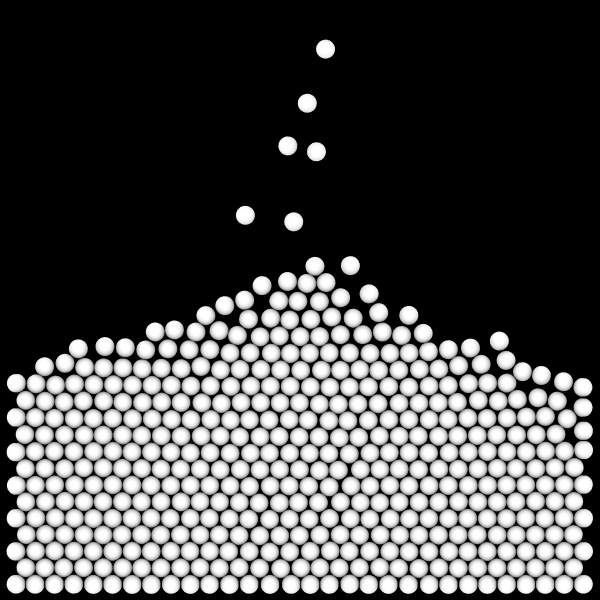
Conclusion
This tutorial showed you how to define interactions in your simulation model via the Hamiltonian.
Navigate to the top of the page and refresh to see the simulation in action again. Notice how the disks fall to the bottom of the boundary and do not overlap, except when newly added. Wait long enough and you will see the simulation clear the bodies.
Complete Code
use hoomd_geometry::shape::Rectangle;
use hoomd_interaction::{
    DeltaEnergyOne, External, MaximumInteractionRange, PairwiseCutoff,
    TotalEnergy, external::Linear, pairwise::Isotropic, univariate::Boxcar,
};
use hoomd_mc::{Sweep, Translate, Trial};
use hoomd_microstate::{
    Body, Microstate, SiteKey, boundary::Closed, property::Point,
};
use hoomd_simulation::{Simulation, macrostate::Isothermal};
use hoomd_spatial::VecCell;
use hoomd_vector::Cartesian;

// Remove the cfg_attr(...) line when using this code outside the hoomd-rs/examples directory.
#[cfg_attr(feature = "bevy", derive(Resource))]
struct Fill {
    /// Positions of all the bodies in the simulation.
    microstate: Microstate<
        Point<Cartesian<2>>,
        Point<Cartesian<2>>,
        VecCell<SiteKey, 2>,
        Closed<Rectangle>,
    >,
    /// How sites interact with other sites and fields.
    hamiltonian: Hamiltonian,
    /// Trial moves to apply.
    translate_sweep: Sweep<Translate<Cartesian<2>>>,
    /// Temperature set point.
    macrostate: Isothermal,
}

impl Fill {
    /// Construct a new fill simulation.
    fn new() -> anyhow::Result<Fill> {
        let box_length = 30.0;
        let maximum_distance = 0.15;
        let alpha = 10.0;
        let epsilon = 1000.0;
        let sigma = 1.0;
        let macrostate = Isothermal { temperature: 1.0 };

        let linear = External(Linear {
            alpha,
            plane_origin: Cartesian::default(),
            plane_normal: [0.0, 1.0].try_into()?,
        });

        let boxcar = Boxcar {
            epsilon,
            left: 0.0,
            right: sigma,
        };
        let pairwise_cutoff = PairwiseCutoff(Isotropic {
            interaction: boxcar,
            r_cut: sigma,
        });

        let hamiltonian = Hamiltonian {
            linear,
            pairwise_cutoff,
        };

        let translate =
            Translate::with_maximum_distance(maximum_distance.try_into()?);
        let translate_sweep = Sweep(translate);

        let square = Rectangle::with_equal_edges(box_length.try_into()?);
        let vec_cell = VecCell::builder()
            .nominal_search_radius(
                hamiltonian.maximum_interaction_range().try_into()?,
            )
            .build();
        let microstate = Microstate::builder()
            .spatial_data(vec_cell)
            .boundary(Closed(square))
            .try_build()?;

        Ok(Fill {
            microstate,
            hamiltonian,
            translate_sweep,
            macrostate,
        })
    }
}

#[derive(TotalEnergy, DeltaEnergyOne, MaximumInteractionRange)]
struct Hamiltonian {
    linear: External<Linear<Cartesian<2>>>,
    pairwise_cutoff: PairwiseCutoff<Isotropic<Boxcar>>,
}

impl Simulation for Fill {
    /// Advance the simulation forward one step.
    fn advance(&mut self) -> anyhow::Result<()> {
        let boundary = self.microstate.boundary();
        let y = boundary.0.edge_lengths[1].get() / 2.0 - 0.5;
        if self.microstate.step().is_multiple_of(100) {
            self.microstate.add_body(Body::point([0.0, y].into()))?;
        }

        self.translate_sweep.apply(
            &mut self.microstate,
            &self.hamiltonian,
            &self.macrostate,
        );
        self.microstate.increment_step();

        if self.hamiltonian.linear.total_energy(&self.microstate) > 20_000.0 {
            self.microstate.clear();
        }

        Ok(())
    }

    /// Get the current simulation step.
    fn step(&self) -> u64 {
        self.microstate.step()
    }
}

// Remove the cfg(not(...)) line when using this code outside the hoomd-rs/examples directory.
#[cfg(not(feature = "bevy"))]
fn main() -> anyhow::Result<()> {
    use hoomd_gsd::hoomd::HoomdGsdFile;
    use hoomd_microstate::AppendMicrostate;

    let mut simulation = Fill::new()?;
    let mut hoomd_gsd_file = HoomdGsdFile::create("applying-interactions.gsd")?;

    for _ in 0..100_000 {
        simulation.advance()?;

        if simulation.step().is_multiple_of(1_000) {
            hoomd_gsd_file
                .append_microstate(&simulation.microstate)?
                .end()?;
        }
    }

    Ok(())
}

#[cfg(feature = "bevy")]
mod applying_interactions_interactive;
#[cfg(feature = "bevy")]
use applying_interactions_interactive::main;
#[cfg(feature = "bevy")]
use bevy::prelude::Resource;
Development of hoomd-rs is led by the Glotzer Group at the University of Michigan.
Copyright © 2024-2026 The Regents of the University of Michigan.